
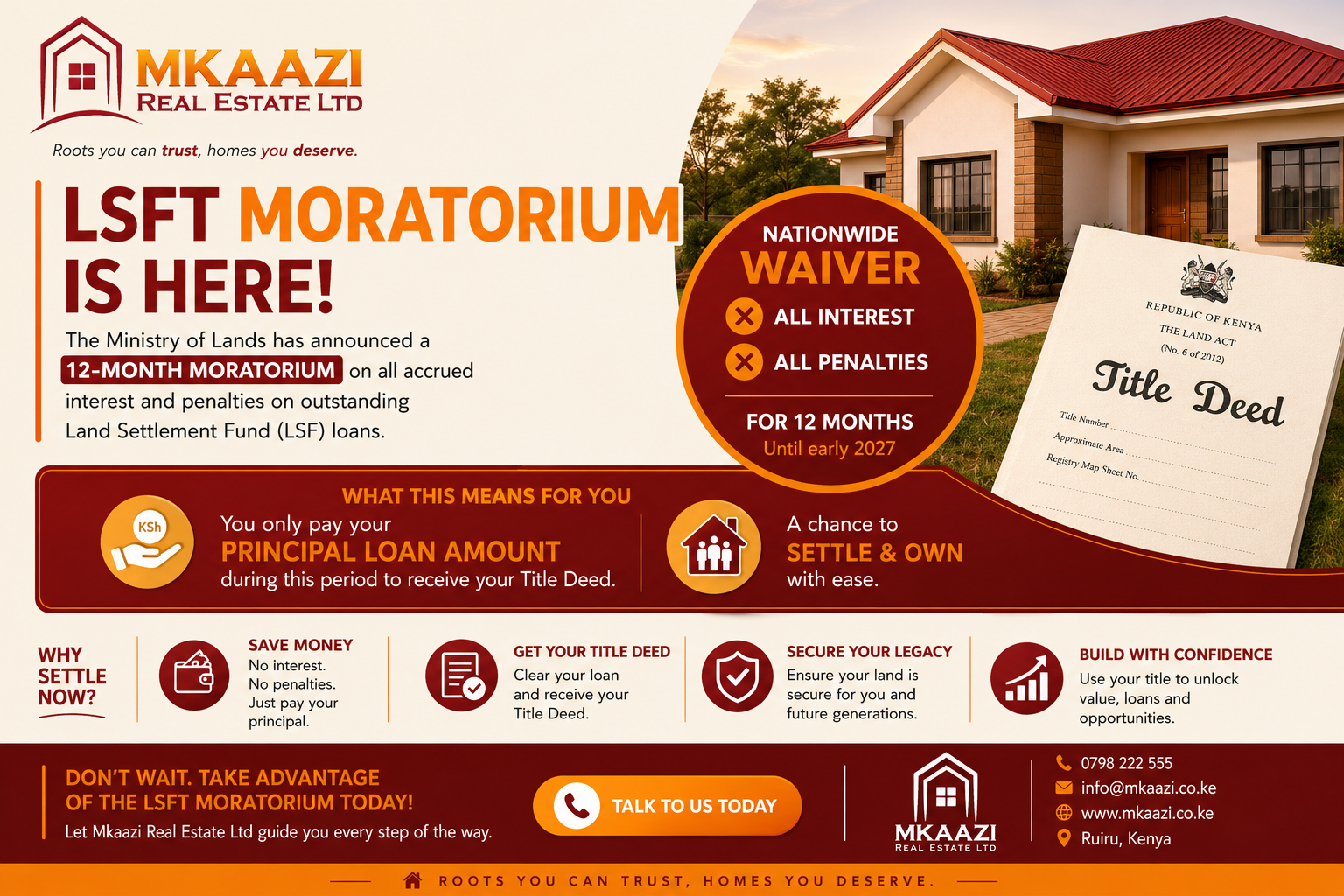
The Kenyan land tenure system allows charges (encumbrances) to be registered against land, securing loans or other obligations. Key laws include the Land Act, 2012 and the Land Registration Act, 2012. Under these laws, a “charge” is broadly defined as an interest in land securing the payment of money or the fulfillment of a condition. Charges include formal mortgages, informal (customary) pledges, and statutory liens (such as unpaid government levies). In settlement schemes, the Land Settlement Fund (LSF) – administered by the Settlement Fund Trustee (SFT) – acquires and allocates land to landless citizens. Beneficiaries pay loans from the LSF, and only upon full repayment are they issued formal title deeds. Notably, a 12-month moratorium (Feb 13, 2026 – Feb 14, 2027) announced by Lands Cabinet Secretary Alice Wahome waives all interest and penalties on LSF loans. During this period, settlers need only pay the principal balance to secure their titles. (After Feb 2027, unpaid balances resume accruing interest.)
Need help with land title matters? Mkaazi Real Estate Ltd offers expert assistance in navigating land charges and LSF discharges. Contact our team for personalized guidance on clearing loans, discharging charges, and obtaining your title deed smoothly.
Legal Framework and Definitions
- Land Act, 2012 (No. 6 of 2012): Establishes settlement programs (Part IX) and the Land Settlement Fund (LSF) (s.135). Section 134 mandates that the National Land Commission (NLC) implement settlement schemes and allocate plots to beneficiaries. Critically, Section 134(7–8) provides that “land acquired in a settlement scheme…shall not be transferable except through a process of succession,” and that beneficiaries “shall pay a sum…as may be determined” by the Commission and trustees. In other words, settlement-scheme land remains encumbered until the obligations (loans) are paid. Section 135 creates the LSF, administered by the NLC, into which parliamentary and donor funds flow to support settlement schemes.
- Settlement Fund Trustee (SFT): Formerly under the Agriculture Act, the SFT Board of Trustees now operates under the Land Act framework. It oversees LSF loans to settlers. In practice, the LSF Board issues letters of offer and holds loan balances, then issues discharge instructions upon full repayment. (After settlement, beneficiaries receive formal title deeds.)
- Land Registration Act, 2012: Governs the registration of all land dealings, including charges. It requires charges to be registered by prescribed instruments (e.g. Form LRA-53 for a charge or LRA-54 for an informal charge). When a charge is created, an entry appears in the register against the title. Any person acquiring the land takes subject to existing registered charges. Removal of a charge is done via Form LRA-58 (Discharge of Charge) (or LRA-59 for partial).
- Charge (definition): As noted above, the Land Act defines a charge as “an interest in land securing the payment of money or money’s worth…”, including sub-charges and instruments creating a charge, and even informal or customary charges under recognized practice. In practice, the most common charge is a bank mortgage: a written instrument giving the bank (chargee) rights over the land until the borrower repays the loan.
Types of Land Charges
| Charge Type | Description & Use Case | Instrument/Form | Remarks |
|---|---|---|---|
| Registered Mortgage/Charge | A formal mortgage securing a loan (bank or SACCO loan). The lender gets an equitable interest until repayment. | Form LRA-53 (Charge) | E.g. bank mortgage over freehold. |
| Statutory Charge | A lien imposed by law (e.g. unpaid land rates, rent, or government dues). Overrides registered title. | No form (per Land Act) | Includes local authority rates; collector of land rent on government leases. |
| Informal/Customary Charge | A community-recognized pledge without formal registration. | Form LRA-54 (Informal Charge) | Rare, but recognized under Land Act if written. |
| Settlement Fund (LSF) Charge | The obligation on settlement-scheme land for unpaid LSF loans. Beneficiaries may not transfer land until paid. | N/A (statutory) / Allotment letter by SFT; discharged via LRA-58 | Essentially statutory; full repayment triggers title. |
(Table: Common charge types under Kenyan land law. All registered charges must be noted in the land register.)
Registering and Searching Land Charges
All dealings must be lodged at the local Land Registry (state department offices by county) or via the online Ardhisasa portal. To register a new charge (e.g. bank loan), one prepares Form LRA-53 (Charge) signed by the owner (chargor) and submits it with: the original title deed, KRA PIN certificate, IDs, and payment of stamp duty and registration fees. For searches, one uses the official land-search form and presents the title deed or lease. For example, obtaining a charge search requires: the land search application form, the original title, KRA PIN (copies) and ID of the applicant, and payment of the search fee (~KSh 500). The Land Registrar will then issue a search report showing all registered charges (and caveats) on the land.
Tip: Always ensure the title deed is clear of errors and that all parties have up-to-date KRA PINs, as the Registrar will reject lodgement without valid PIN certificates. Clearing any land rates or obtaining Land Control Board consent (for agricultural plots) should be done in advance to avoid delays.
Discharging a Land Charge: Step-by-Step
Once a secured loan is fully repaid, the charge must be formally removed. The Land Act 2012 and Land Registration Act 2012 govern this process. Below is a detailed guide:
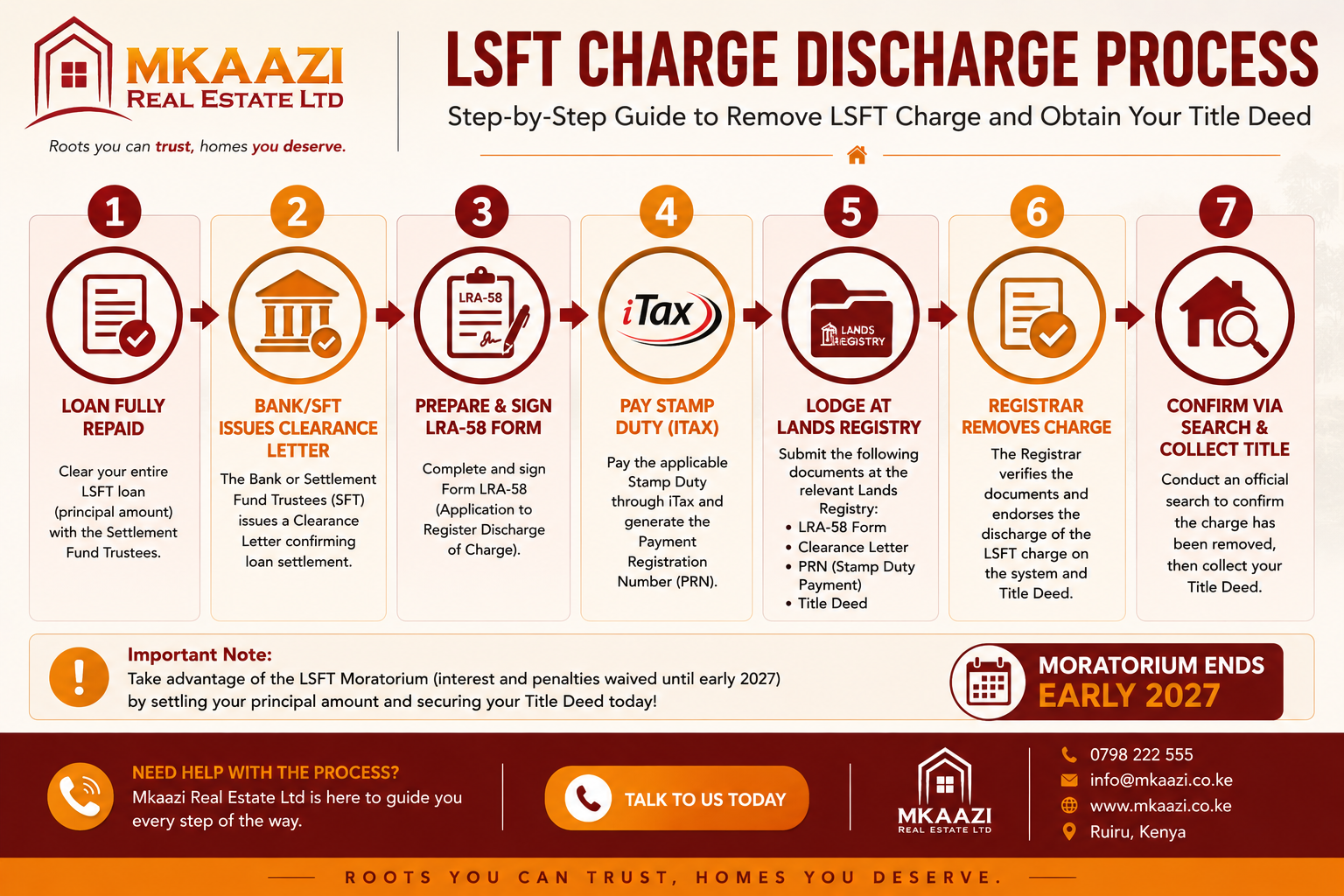
- Full Loan Repayment & Clearance Letter (Borrower & Lender). The borrower (“chargor”) pays the remaining principal, interest and any penalties. The lender confirms closure by issuing a loan redemption/clearance letter. This letter (bearing the bank’s stamp and signature) should state the final balance, repayment date, and consent to discharge. The lender should also ensure any caveats or cautions it lodged are withdrawn, as the Registrar will not register a discharge with pending caveats.
- Prepare the Discharge Instrument (Form LRA-58). A Discharge of Charge document is drafted, typically by the borrower’s advocate. Form LRA-58 (full discharge) or LRA-59 (partial release) is prescribed by law. The form must include: title particulars (title number, location), details of the original charge (date, parties, instrument number) and a declaration that the debt has been paid. The chargee (lender or SFT) signs this form, witnessed by an advocate or public officer. Mkaazi’s conveyancing team can prepare and execute this form promptly once the clearance letter is in hand.
- Stamp Duty (KRA Clearance). Before lodging, the discharge instrument must be stamped for duty under the Stamp Duty Act (Cap. 480). In 2026, this is done electronically via the Kenya Revenue Authority’s iTax portal. Log in with the borrower’s KRA PIN, generate a stamp duty slip under the “Stamp Duty” menu, and pay the indicated amount (typically 0.05% of the amount discharged). KRA issues an electronic receipt/bill reference on payment. The signed discharge document must then bear the KRA stamp or have the payment evidence ready to lodge. No certificate will be registered without this proof of stamp duty.
- Lodgement at Lands Registry (ArdhiSasa or Manual). The following package is submitted to the Registrar (at the district registry where the land is registered):
- Form LRA-58 (original), duly signed by the lender and stamped.
- Original Certificate of Title (or current title deed).
- Lender’s Clearance Letter (original).
- KRA Stamp Duty Receipt (electronic payment confirmation).
- Certified ID/Passport Copies and KRA PIN Certificates for all parties.
- Consent Forms, if applicable (e.g. Land Control Board consent for farming land; Commissioner of Lands consent for certain lease transfers).
- Passport-size Photos of parties (often 1–2 per party).
- Lands Registry Fees: a small registration charge (see below) and any title fees. The registry clerk will assign a presentation number and check all documents. If anything is missing or incorrect (e.g. an unsigned page, inactive PIN), the whole lodgement can be rejected, so double-check the checklist. Electronic lodgement via ArdhiSasa can speed up processing, but the package requirements are the same.
- Registration of Discharge. Once lodged, the Registrar processes the application. If satisfied, they will enter the discharge on the land register, which removes the charge entry from the title. This effectively restores the owner’s full, unencumbered title. The Registrar then returns the title deed (with the new endorsement) to the owner or their advocate. Typical turnaround is 7–21 business days if using the e-portal; manual lodgements can take longer.
- Final Search and Title Issue. After registration, it is good practice to obtain an official land search to verify the charge is fully removed. The Registrar’s register index or new certificate will show no outstanding charge. Finally, the updated Certificate of Title is issued to the owner. If the discharge was part of a sale, the advocate would simultaneously lodge the transfer instrument to the buyer, using a similar process (including new stamping for transfer and Capital Gains Tax as needed).
Required Documents Checklist:
- Discharge Instrument (LRA-58) signed & witnessed.
- Original Title Deed.
- Clearance Letter from lender.
- KRA stamp duty evidence (receipt).
- Valuation report (if KRA requires for stamp duty).
- IDs & KRA PIN certificates.
- Land Control/Commissioner Consents if required.
- Passport photos of parties.
- Registry fees (as per Land Act/KRA fee schedule).
Note on Fees: The State Department of Lands charges 0.05% of the secured amount as the discharge fee, plus a flat KSh 1,000 registration fee and KSh 2,500 title issuance fee. (Banks may factor these into the loan payoff.)
Here is a high-level flow of the discharge process:
Discharging Land Settlement Fund (LSF) Loans
For settlement scheme land, the process is similar but involves the Settlement Fund Trustee as lender. Beneficiaries of an LSF loan (often called “settlers” or “allottees”) must pay the principal to obtain title. Upon final repayment, the Trustee provides a clearance of allotment or discharge instruction. The settler then follows the same steps above: executing a discharge instrument (LRA-58), stamping it, and lodging at the registry. The key difference is that settlement scheme land is statutorily restricted: by law it cannot be transferred until the loan is cleared. Once the process is done, the Trustee will endorse the removal of any statutory charge, and the NLC can issue a full title deed to the beneficiary. During the current moratorium, lands’ department websites allow beneficiaries to view their outstanding principal balance online. Mkaazi Real Estate Ltd can assist settlers in coordinating with the Settlement Fund Trustee, obtaining the necessary loan statements, and guiding the discharge preparation so that you receive your title promptly.
12-Month Moratorium: What You Need to Know
In March 2026 the government announced a 12-month waiver on all interest and penalties for LSF loans, running from Feb 13, 2026 to Feb 14, 2027. Practically, this means settlers pay only the principal balance during this window; all accrued interest has been scrapped. It provides a unique opportunity: by paying off just the principal now, beneficiaries can trigger title issuance without the burden of past interest costs. (After Feb 2027 any unpaid principal will start accruing interest again.) This waiver covers all existing SFT loans, as confirmed by the Lands CS. For many families, clearing just the remaining capital will secure ownership.
Example: If your principal balance is KSh 500,000 as of Feb 2026, you only need to pay KSh 500,000 to receive your title – no extra. Mkaazi Real Estate recommends clients use this moratorium to finalize payments. We can liaise with the Settlement Fund Trustee to obtain your final payoff figures and arrange payment. Remember: even with the waiver, you must still execute the discharge steps (prepare the LRA-58, stamp it, etc.) to get the deed. The Land Registry will not automatically issue deeds; the statutory registration formalities must still be completed.
Practical Tips and Common Pitfalls
- Prepare all documents in advance: Gather your title deed, KRA PIN, IDs, and any consent forms early. Ensure your KRA PIN is active (the Registry rejects lodgement if a PIN is inactive).
- Clear any caveats or charges: Before repayment, ask the lender to withdraw any caveats it has lodged. Outstanding caveats will block the discharge registration.
- Spousal/Board Consents: For joint property, get spousal consent as required by Land Act 2012. For agricultural plots (outside urban areas), obtain a Land Control Board consent before transfer. These must accompany the lodgement.
- Land Rates and Rent: While usually tied to sales/transfers, ensure that local property rates or government rent (if applicable) are paid up to date. Some registries require a rent clearance for leases. Checking with your local sub-county may be prudent.
- Use the correct forms: A common error is using the wrong LRA form or outdated format. Always download the latest LRA forms from the Lands department (see Ardhi Forms). For part-payment, use LRA-59 (Partial Discharge).
- Stamping accuracy: Make sure the details (names, title number, amounts) on your stamp duty iTax slip match those on the discharge and any concurrent transfer. Typos or mismatches can cause rejection.
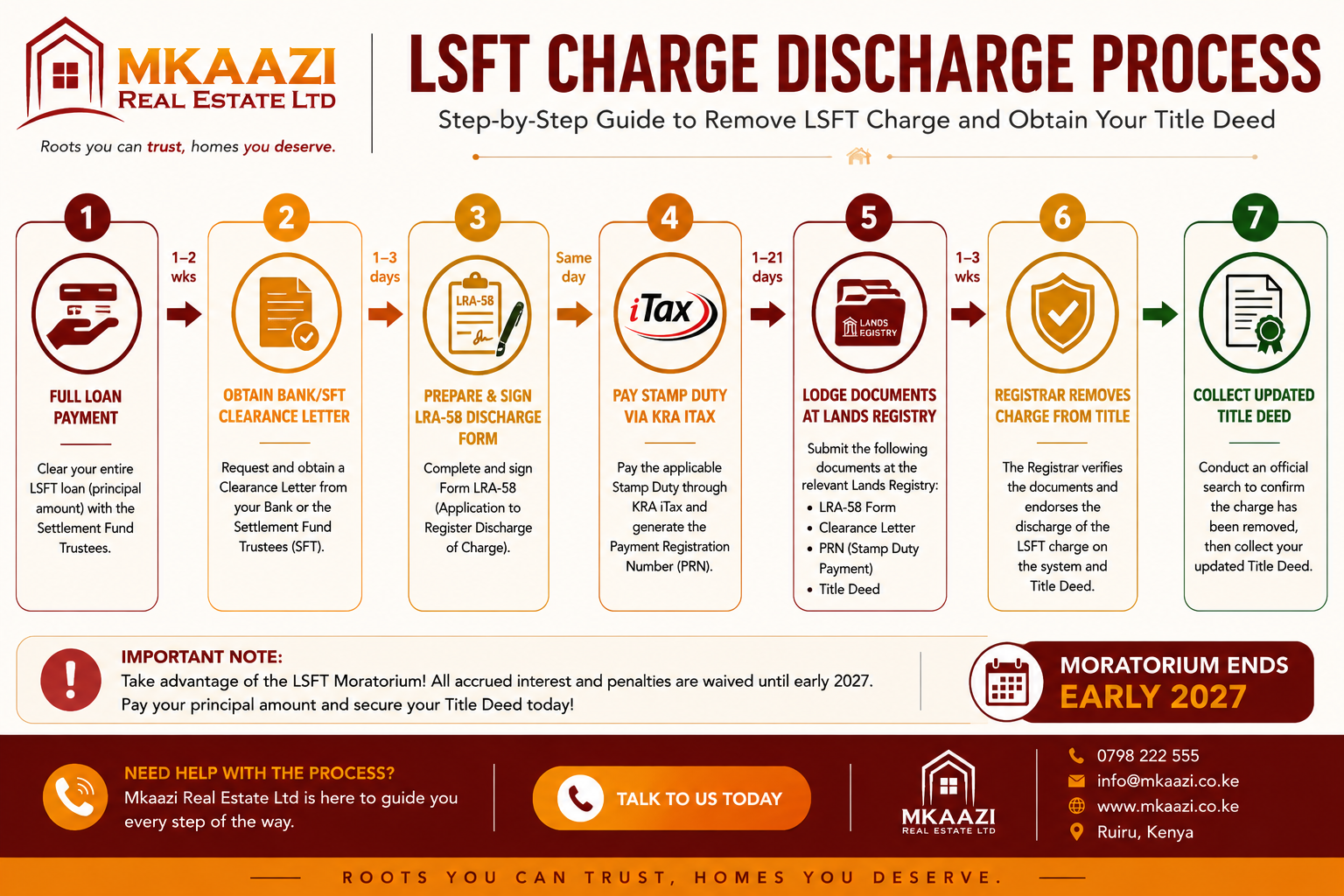
- Timeline: Plan ahead. Banks typically issue clearance letters in 1–2 weeks after payoff. KRA can take 1–4 weeks for valuation during busy times. Lands Registry processing is now often 1–3 weeks (online). Factor in possible delays around year-end or fiscal deadlines.
Comparison Table: Key Steps & Documents
| Step | Action/Notes | Documents Needed |
|---|---|---|
| 1. Repay Loan in Full | Borrower pays all principal (and any required fees) to lender. | Bank/SFT payment receipt; loan closure certificate. |
| 2. Obtain Clearance Letter | Lender issues official letter confirming zero balance and consenting to discharge. | Lender’s signed clearance letter (on letterhead). |
| 3. Prepare Discharge Instrument | Fill Form LRA-58 (or LRA-59). Have lender sign and witness. | Signed Form LRA-58 (on stamped paper), banker’s signature. |
| 4. Stamp at KRA | Compute and pay 0.05% stamp duty on discharge via iTax. Get receipt. | KRA iTax stamp duty payment receipt/bill reference. |
| 5. Lodge at Land Registry | Submit package to Registry (ArdhiSasa or counter). | Stamped LRA-58; Original Title Deed; Clearance letter; KRA receipt; IDs & PINs; Photos; Consents; Fees. |
| 6. Registrar Processes | Registrar verifies docs, registers discharge entry, removes charge. | – |
| 7. Confirm & Collect Title | Conduct search to confirm charge removal; collect new title deed. | Official search results; signed copy of updated title. |
(Checklist: Ensure each item is complete to avoid rejections.)
Timeline Overview
- Day 0: Final loan repayment made; account closed.
- Days 1–7: Bank/SFT issues clearance letter.
- Days 7–14: Prepare & execute LRA-58; start KRA stamping.
- Days 14–30: Complete KRA valuation/payment; lodge discharge package at Land Registry.
- Days 30–60: Registrar enters discharge, issues clean title (plus new title if a sale).
(Timeline can vary by region; e-portal lodgements tend to be faster.)
Chart: Discharge of Charge Process
Conclusion and CTAs
Understanding land charges and the Land Settlement Fund process is crucial to securing property rights in Kenya. By following the above steps and preparing the required documentation, landowners can efficiently remove encumbrances and obtain clean title deeds. Mkaazi Real Estate Ltd specializes in these conveyancing services. Our experienced team can coordinate with lenders or the Settlement Fund Trustee, ensure correct document preparation, and interact with KRA and the Lands Registry on your behalf.
Don’t navigate this complex process alone. Contact Mkaazi Real Estate Ltd today for expert assistance in discharging land charges and clearing your LSF loan. With our help, you can capitalize on the moratorium (paying principal only) and get your formal title without undue delay.
Sources: Official Kenyan statutes and guidelines, including the Land Act, 2012, Land Registration Act, 2012, and State Lands Department resources, as well as government announcements on the LSF loan waiver. Detailed procedural guidance is drawn from legal practice sources and government form instructions.






Join The Discussion