
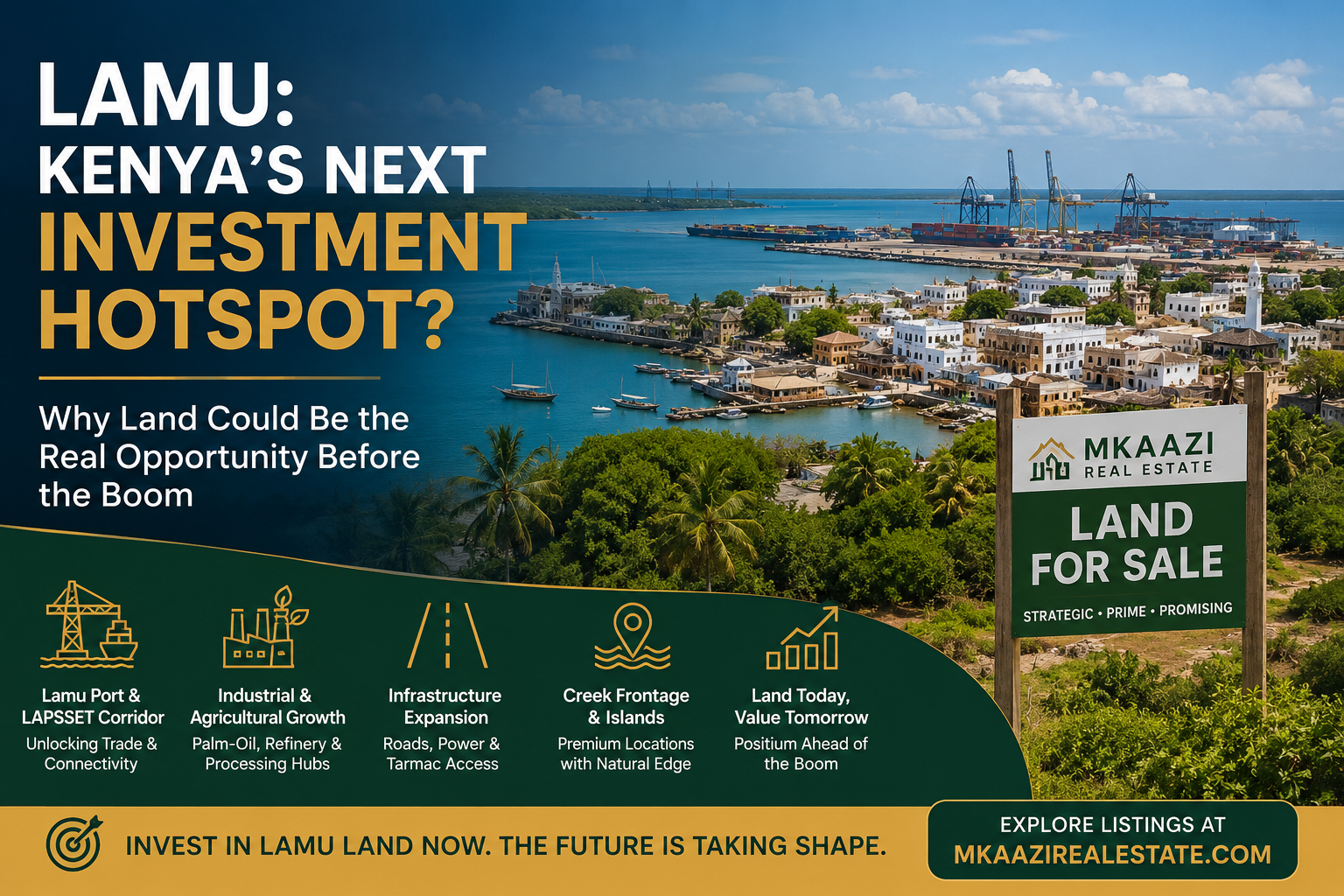
Lamu has always had the beauty. Now it may be acquiring the economic engines.
For decades, Lamu has occupied a unique position in Kenya’s coastal economy. It has been celebrated for its UNESCO-listed heritage, beaches, islands, traditional architecture, tourism and laid-back lifestyle.
But a different Lamu is beginning to emerge.
The county is increasingly being positioned not simply as a tourism destination, but as a potential industrial, agricultural, energy and logistics hub for the northern coast and East Africa.
And for property investors, this distinction matters.
Because when major infrastructure and industrial projects begin moving from concept to implementation, the most significant change does not always happen first in the price of developed property.
It often happens in the price and strategic importance of land.
Recent developments suggest that Lamu could be entering precisely that stage.
Two major proposed investments have recently put the county back into the spotlight: a proposed $100 million palm-oil processing plant at Witu Nyangoro Ranch and plans for a proposed $15.5–$16 billion petroleum refinery associated with Aliko Dangote.
Neither project should be treated as a completed investment yet. The palm-oil project remains in the final investment-discussion stage, while the refinery is reportedly targeting construction commencement in October 2026.
But that is exactly what makes the current moment interesting for land investors.
The question is not whether every announced project will necessarily be delivered exactly as planned.
The question is:
What happens to land values when investors begin positioning themselves ahead of major economic infrastructure?
Lamu Could Be Entering Its Infrastructure-Led Growth Cycle
Real estate investors often look at property markets through a simple lens: population growth, tourism, housing demand and commercial activity.
But some of the most powerful land-value increases occur when something much larger changes the economic geography of a region.
A new highway can do it.
A new port can do it.
A railway can do it.
A major industrial plant can do it.
A logistics corridor can do it.
And when several of these factors begin converging in the same geographic area, the potential impact on land becomes considerably more interesting.
Lamu already has one of those major anchors: Lamu Port.
The Kenya Ports Authority describes the Port of Lamu as a transformative hub for regional trade, while Kenya’s investment plans identify opportunities around port development and the Lamu Special Economic Zone.
That creates an important foundation.
The port is not simply a piece of infrastructure sitting beside the ocean.
Ports generate ecosystems.
They require transport.
Warehousing.
Container yards.
Fuel stations.
Vehicle yards.
Maintenance facilities.
Accommodation.
Offices.
Retail.
Food and hospitality.
Security.
Logistics companies.
Industrial suppliers.
Workforce housing.
And, ultimately, land.
This is why the long-term investment story surrounding Lamu may be considerably larger than the port itself.
The $100 Million Palm-Oil Project Could Create a New Economic Node
One of the most interesting recent announcements is the proposed Lamu palm-oil processing plant.
The proposed facility is valued at approximately KSh12.9 billion ($100 million) and is targeted for Witu Nyangoro Ranch in Lamu County.
The project could create approximately 3,000 jobs and would form part of Kenya’s effort to expand domestic palm-oil production and processing.
That is significant for several reasons.
First, the plant would not operate in isolation.
A large agricultural processing facility needs a supply chain.
Farmers need to produce the raw material.
Trucks need to move agricultural produce.
Storage facilities are required.
Machinery and equipment need servicing.
Workers need accommodation.
Businesses need to supply food, transport, maintenance, security and other services.
Manufacturers and distributors need commercial space.
And all of these activities create secondary economic demand.
That is precisely the kind of multiplier effect that property investors should watch.
The factory itself occupies a relatively defined footprint.
The economic ecosystem surrounding it can occupy a much larger one.
Then There Is the Much Bigger Energy Story
If the palm-oil project is the agricultural component of Lamu’s emerging industrial story, the proposed Dangote refinery represents the potential energy component.
The proposed refinery is estimated at approximately $15.5–$16 billion, with construction reportedly targeted for October 2026.
These figures are enormous.
But property investors should not simply look at the headline investment figure.
They should ask:
What happens around a project of this scale?
A refinery requires an enormous supporting ecosystem.
Engineering.
Construction.
Transport.
Logistics.
Storage.
Security.
Accommodation.
Food services.
Vehicle services.
Professional services.
Industrial contractors.
Maintenance companies.
Worker accommodation.
And potentially additional manufacturing and processing businesses attracted by the availability of energy infrastructure and industrial connectivity.
This is where the land story becomes particularly compelling.
The Real Estate Opportunity May Come Before the Projects
There is a recurring pattern in infrastructure-led property markets.
The biggest land gains can occur before the infrastructure is fully operational.
Why?
Because once a major project becomes operational, much of the investment thesis has already been priced into the market.
Early investors are taking a different kind of risk.
They are buying land based on the expectation that infrastructure will eventually transform the surrounding economy.
That is speculative investment.
And speculation is not necessarily a negative word in real estate.
Land banking is inherently speculative.
You acquire an asset today because you believe its strategic value will be greater tomorrow.
The challenge is identifying which speculation is supported by genuine economic fundamentals and which is simply driven by hype.
Lamu increasingly has some of the fundamentals investors look for.
Lamu Has Already Demonstrated What Infrastructure Can Do to Land Prices
This is not entirely theoretical.
Lamu’s mainland areas have already experienced significant land-price movements associated with infrastructure development.
Historical reporting around Lamu Port documented substantial increases in land values in areas such as Hindi and Mokowe.
The lesson for today’s investor is important:
Infrastructure can change the economic value of land long before the surrounding area looks completely transformed.
That is why investors should be watching Lamu now.
Where Could the Opportunity Be?
Not every piece of land in Lamu will benefit equally.
Buying “land in Lamu” is not an investment strategy.
Buying the right land in the right emerging economic corridor is.
Investors should be looking for land with a combination of:
- Proximity to major infrastructure
- Reliable road access
- Proximity to emerging population centres
- Industrial or logistics potential
- Residential development potential
- Commercial potential
- Agricultural potential
- Clear title and verifiable ownership
- A realistic long-term exit strategy
And this is where Mkaazi Real Estate’s current Lamu portfolio becomes particularly relevant.
Mkaazi Investment Opportunity: 26,000 Acres Along the LAPSSET Corridor
For investors thinking on a genuinely large scale, Mkaazi Real Estate is marketing a 26,000-acre strategic landholding along the LAPSSET Corridor in Lamu, with creek and mangrove frontage.
This is not a conventional residential land investment.
It is a large-scale land-banking opportunity positioned around one of the most important infrastructure corridors in Kenya.
The combination of scale, corridor positioning and waterfront characteristics makes this type of property particularly relevant to investors considering long-term agricultural, conservation, logistics, hospitality or other large-scale development possibilities.
Why it matters
Large contiguous parcels in emerging infrastructure corridors can become strategically valuable because future development often requires land at scale.
Instead of trying to assemble hundreds or thousands of acres later—when ownership becomes fragmented and prices may have risen—an investor can potentially acquire strategic land before development pressure intensifies.
For investors looking for a major LAPSSET land-banking opportunity, this property deserves a closer look.
👉 View the 26,000-acre LAPSSET Corridor property
Contact Mkaazi Real Estate to discuss the location, investment structure and viewing arrangements.
Hindi: An Area Worth Watching Closely
If Lamu is going through an infrastructure-led transformation, Hindi deserves particular attention.
Hindi sits within the mainland economic geography influenced by Lamu Port, road infrastructure and the wider LAPSSET development corridor.
It is precisely the kind of location where land investors should be asking:
What could this land become as infrastructure and population expand?
Mkaazi Real Estate currently has prime plots for sale in Hindi Reserve, Lamu, offering investors an opportunity to enter the market at a smaller scale than the large agricultural and strategic landholdings.
This makes the Hindi opportunity potentially attractive to investors who want exposure to the Lamu growth story without acquiring hundreds or thousands of acres.
A potential entry point for smaller investors
Land banking does not have to mean buying a huge ranch.
A strategically located plot can provide an entry point for an investor who intends to hold for several years and potentially benefit from future residential or commercial demand.
👉 Explore prime plots for sale in Hindi Reserve, Lamu
Looking to secure land in Hindi before further infrastructure-led development? Contact Mkaazi Real Estate for availability and viewing arrangements.
Near Lamu Port: 15 Acres for the Long-Term Investor
For investors who want a parcel large enough to provide multiple future options, Mkaazi is also marketing 15 acres of investment land near Lamu Port.
The importance of land near major infrastructure is not necessarily what can be built on it today.
It is what the land could potentially support as the surrounding economic ecosystem develops.
A 15-acre holding can provide flexibility for future subdivision, residential development, commercial use, hospitality, logistics or other permitted uses—subject, of course, to planning, zoning, environmental and statutory approvals.
For a land banker, that flexibility can be valuable.
👉 View the 15-acre investment land near Lamu Port
Ask Mkaazi Real Estate about this opportunity if you are looking for strategically positioned land near Lamu Port with a longer investment horizon.
Kauthara: 5 Acres Near Lamu Port
Another opportunity for investors looking for a more manageable parcel is Mkaazi’s 5-acre investment property in Kauthara near Lamu Port.
Five acres sits in an interesting middle ground.
It is substantial enough for serious development or land-banking strategies, but considerably more accessible than a multi-hundred-acre acquisition.
For investors who believe Lamu’s infrastructure story will continue developing over the next five to ten years, properties such as this can provide an opportunity to establish a position without committing to an exceptionally large landholding.
👉 Explore the 5-acre investment land near Lamu Port in Kauthara
Interested in the Kauthara opportunity? Contact Mkaazi Real Estate to arrange a site visit and conduct your due diligence.
Creek Frontage + Tarmac Access: A Different Kind of Lamu Investment
Not every investor is looking purely for industrial or logistics exposure.
Some want the infrastructure story combined with the lifestyle and tourism potential that makes Lamu unique.
That is where Mkaazi’s 2-acre tarmac and creek-front property near Lamu Port becomes particularly interesting.
Creek frontage gives the property a completely different dimension.
Depending on planning and environmental approvals, waterfront land can potentially support hospitality, residential, leisure or other carefully designed coastal developments.
At the same time, tarmac access provides something that is increasingly important in emerging markets:
connectivity.
The combination of waterfront character and road accessibility creates a potentially attractive proposition for an investor who wants exposure to both the economic and lifestyle sides of the Lamu story.
👉 View the 2-acre tarmac and creek-front property near Lamu Port
Looking for a Lamu property that combines accessibility, waterfront character and long-term investment potential? Talk to Mkaazi Real Estate about this opportunity.
Why These Properties Matter to the Bigger Lamu Story
These five opportunities illustrate something important.
There is no single way to invest in an emerging property market.
Different investors can take different positions.
The large-scale investor
The 26,000-acre LAPSSET corridor property represents a strategic land-banking proposition for investors thinking in terms of scale and long-term regional development.
The emerging investor
The Hindi plots provide a potentially more accessible entry into the Lamu mainland property market.
The strategic land banker
The 15-acre property near Lamu Port offers a substantial holding with multiple potential future applications.
The mid-sized investor
The 5-acre Kauthara property provides exposure to the Lamu Port growth story at a more manageable scale.
The coastal lifestyle investor
The 2-acre tarmac and creek-front property combines potential infrastructure exposure with the unique waterfront character that continues to make Lamu attractive.
This is exactly why Lamu deserves closer attention.
It isn’t a one-dimensional investment story.
The Lamu Investment Thesis in One Sentence
If you had to reduce the entire Lamu investment thesis to one sentence, it would be this:
Buy strategically located land before infrastructure, employment and population growth fully price the future into the market.
That does not mean buying blindly.
It means identifying locations where multiple growth drivers overlap.
Port.
Road.
Industry.
Agriculture.
Energy.
Tourism.
Population.
And then asking whether the land you are considering sits within the path of that growth.
But Do Not Confuse Opportunity With Certainty
This is where investors need to be disciplined.
The proposed palm-oil plant is not yet operational.
The refinery remains a proposed major investment.
Infrastructure projects can be delayed.
Approvals can change.
Financing can change.
Construction timelines can move.
Market conditions can change.
Land investors should therefore avoid buying solely because a salesperson tells them:
“A refinery is coming.”
Instead, look for multiple independent reasons why the land could have value.
For example:
Port + road + existing settlement + industrial activity + clean title
is considerably more compelling than:
announced project + cheap land.
The Biggest Mistake Could Be Buying the Cheapest Land
There is a temptation in emerging markets to ask:
“Where can I buy the cheapest acre?”
That is often the wrong question.
A better question is:
“Which acre has the greatest probability of becoming more valuable?”
A cheap parcel with poor access may remain cheap for years.
A more expensive parcel with good access, clear ownership, proximity to infrastructure and strong future demand may have considerably better investment prospects.
Land value is ultimately about:
Accessibility + utility + scarcity + demand + legal certainty.
Cheap land is not necessarily undervalued land.
What Smart Lamu Land Investors Should Be Doing Now
Anyone considering buying land in Lamu should undertake proper due diligence.
That means verifying:
Title
Confirm ownership, tenure, encumbrances and the legal status of the property.
Survey
Confirm actual boundaries and acreage.
Access
Determine whether the property has legal and practical road access.
Planning
Understand current and proposed zoning and land-use plans.
Infrastructure
Check the status of roads, electricity, water, telecommunications and other services.
Environmental considerations
Lamu contains environmentally sensitive coastal and mangrove ecosystems. Environmental and planning considerations must therefore be taken seriously.
Project proximity
Do not rely on claims that a property is “near the refinery” or “next to the port.”
Verify the actual location.
Exit strategy
Ask:
Who will eventually buy this land from me?
The best land investment is not necessarily the one with the most exciting story.
It is the one with the clearest future pool of buyers.
The Investment Clock Is Already Moving
One of the most interesting aspects of Lamu’s story is that the market does not have to wait for every planned project to be completed before land values begin responding.
Markets anticipate.
Developers anticipate.
Businesses anticipate.
Landowners anticipate.
Once enough participants believe that a particular area is becoming economically important, land prices can begin moving before the cranes arrive.
This is why infrastructure announcements matter.
And it is why the current period could represent an interesting window for long-term land investors.
The proposed $100 million palm-oil facility adds an agricultural and manufacturing dimension.
The proposed multibillion-dollar refinery adds an energy dimension.
Lamu Port provides the logistics dimension.
LAPSSET provides the broader regional-corridor dimension.
Tourism provides an established economic base.
Together, these factors create a much more interesting investment proposition than any single project could provide.
Is Lamu Kenya’s Next Investment Hotspot?
It may be.
But the more useful question for investors is not whether Lamu will suddenly become “the next Nairobi” or “the next Mombasa.”
It won’t.
Lamu has its own economic identity.
Its opportunity lies in becoming a strategic northern coastal economic hub, combining tourism with agriculture, logistics, energy and industrial development.
And that could make land one of the most interesting asset classes in the county over the coming decade.
The investors who may benefit most are unlikely to be those who wait until every project is complete.
By then, the market will have already repriced.
The opportunity may instead belong to investors who identify strategically located land while the transformation is still underway, undertake proper due diligence, accept the risks associated with a long holding period and position themselves ahead of future demand.
That is the essence of land banking.
You are not buying today’s Lamu.
You are investing in the possibility of tomorrow’s Lamu.
Explore Lamu Land Investment Opportunities with Mkaazi Real Estate
At Mkaazi Real Estate, we believe the emerging Lamu story deserves serious attention from investors looking beyond traditional coastal property markets.
Our current Lamu portfolio includes opportunities ranging from strategic large-scale landholdings along the LAPSSET corridor to smaller investment plots, land near Lamu Port, creek-front properties and development opportunities in emerging areas such as Hindi and Kauthara.
Whether you are a local investor, Kenyan diaspora buyer, institutional investor, developer or long-term land banker, we can help you identify opportunities based on:
- Location
- Accessibility
- Proximity to infrastructure
- Development potential
- Land size
- Investment horizon
- Title and ownership documentation
- Intended use
Ready to explore Lamu?
Don’t wait until the cranes arrive to start looking for land.
Speak to Mkaazi Real Estate about currently available Lamu investment opportunities and arrange a site visit.
Mkaazi Real Estate Ltd
Kenya Coast Property Specialists
📞 +254 763 56 8989
📞 +254 724 56 8989
🌐 www.mkaazirealestate.com
Your next investment could be in the path of Lamu’s growth.
Investment Disclaimer: This article is for general information and investment education only and should not be interpreted as financial, legal or investment advice. Proposed projects discussed in this article remain subject to financing, approvals, planning, construction and other conditions. Past land-price movements do not guarantee future returns. Property availability, pricing and development potential may change. Prospective purchasers should undertake independent legal, survey, planning, environmental and financial due diligence before purchasing property.




Join The Discussion