

The Hidden Challenges of Freehold Ownership Every Land Investor Should Know , A Comprehensive Guide by Mkaazi Real Estate Ltd
Kenya’s property market continues to attract local, diaspora, and international investors seeking opportunities in residential developments, agriculture, tourism, conservation, and commercial real estate. Freehold land is often marketed as the ultimate form of ownership—a title that grants indefinite rights over land without the expiry dates associated with leasehold tenure.
While freehold ownership certainly offers significant advantages, many investors are surprised to learn that owning freehold land in Kenya can be far more complicated than it appears.
From constitutional restrictions affecting foreign investors to zoning regulations, county approvals, land rates, conversion costs, planning controls, succession disputes, and environmental restrictions, freehold ownership comes with responsibilities and risks that are often overlooked during the purchase process.
At Mkaazi Real Estate Ltd, we regularly assist clients navigating these complexities. This guide explores the realities of freehold ownership in Kenya, highlights common pitfalls, and explains what investors should know before committing to a purchase.
What Is Freehold Land?
Freehold land is property held in perpetuity, meaning ownership does not expire after a fixed term.
Traditionally, freehold ownership has been viewed as the most secure form of tenure because it offers:
- Permanent ownership rights
- Greater control over succession and inheritance
- Freedom from lease expiry concerns
- Long-term capital appreciation potential
- Greater flexibility for agricultural and rural land use
However, ownership rights are not absolute. Freehold land remains subject to the Constitution of Kenya, county planning laws, environmental regulations, land use controls, taxation, and other statutory obligations.
This is where many investors encounter unexpected challenges.
The First Challenge: Foreigners Cannot Own Freehold Land in Kenya
One of the most important legal realities is that non-citizens cannot legally own freehold land in Kenya.
Article 65 of the Constitution of Kenya restricts foreign individuals and foreign-owned companies to leasehold interests of up to 99 years.
This means:
- Foreign buyers cannot directly acquire freehold titles.
- Foreign-owned companies cannot hold freehold land.
- Existing freehold interests involving non-citizens must be converted into leasehold tenure.
- Transactions that fail to comply with constitutional requirements may be rejected by the land registry.
For international investors, this creates an immediate layer of complexity. A property marketed as “freehold” may require conversion before ownership can legally transfer.
Many buyers discover this only after negotiations have begun, resulting in delays, additional costs, and sometimes collapsed transactions.
Why Conversion from Freehold to Leasehold Can Be Costly
A common misconception is that converting freehold land to leasehold is a simple paperwork exercise.
In reality, conversion can involve a lengthy administrative and legal process requiring approvals from multiple government agencies.
Typical requirements may include:
- Land valuation
- Survey verification
- Planning approvals
- Legal documentation
- County government clearances
- National Land Commission processes
- Registration fees
- Professional consultancy fees
Depending on the property’s location, size, value, and intended use, it costs between 2-4% of the property value, and can approach or exceed KES 1 million.
For high-value urban, coastal, or commercial properties, expenses may be significantly higher.
Many investors budget for stamp duty and legal fees but fail to account for conversion-related costs.
The Timeline Problem: Expect Delays
Another challenge is time.
Even when all documents are properly prepared, conversion processes often take several months.
Typical timelines include:
- Document preparation
- Verification of ownership records
- Survey review
- County approvals
- National approvals
- Lease preparation
- Registration
While some applications progress relatively smoothly, six months is often considered optimistic.
It is not unusual for applications to extend beyond one year, particularly where records require correction or additional approvals are needed.
Investors operating on tight project timelines should factor this reality into their acquisition strategy.
Applications Can Be Rejected
Perhaps the most frustrating aspect of the process is that approval is not guaranteed.
Applications may be delayed or rejected due to:
- Missing documentation
- Errors in survey plans
- Boundary disputes
- Historical ownership inconsistencies
- Succession disputes
- Planning conflicts
- Encumbrances on the title
- Incomplete regulatory approvals
In some cases, investors may incur substantial professional costs before discovering that an application cannot proceed.
This underscores the importance of conducting due diligence before signing a sale agreement.
The Myth of “No Ongoing Costs”
Many buyers assume that because freehold ownership is perpetual, it comes with fewer ongoing obligations than leasehold property.
The reality is more nuanced.
County Land Rates
While freehold land generally does not attract annual government land rent in the traditional leasehold sense, county governments levy annual land rates on many properties.
Failure to pay rates can lead to:
- Penalties and interest
- Restrictions on title transfers
- Delays in obtaining clearance certificates
- Legal enforcement action
Before purchasing any property, investors should verify whether outstanding rates exist.
Infrastructure and Utility Levies
Depending on location, property owners may also encounter charges associated with:
- Urban infrastructure improvements
- Road reserves
- Sewer systems
- Service provision upgrades
These obligations vary between counties and municipalities.
Compliance Costs
Owning land often involves ongoing compliance requirements, including:
- Environmental assessments
- Building approvals
- Survey updates
- Change-of-user applications
- Physical planning approvals
These costs can accumulate significantly over the lifetime of ownership.
County Governments Can Restrict What You Do with Your Land
One of the biggest surprises for investors is discovering that ownership does not automatically grant unrestricted development rights.
County governments regulate land use through zoning and planning frameworks.
These frameworks determine:
- Permitted land uses
- Building heights
- Density limits
- Plot coverage ratios
- Environmental setbacks
- Infrastructure reservations
- Commercial and industrial activities
A property that appears ideal for apartments, a hotel, warehouse, school, or shopping centre may not be approved for that use.
Before purchasing land, investors should confirm its zoning status and development potential.
Understanding City and County Demarcations
Urban expansion is transforming many parts of Kenya.
Areas that were once considered rural are increasingly being incorporated into municipal and urban planning zones.
This can introduce new restrictions and obligations, including:
- Development controls
- Infrastructure reservations
- Road expansion corridors
- Environmental protection measures
- Utility requirements
Investors purchasing land on the outskirts of rapidly growing towns should investigate current and future planning designations.
This is particularly important in:
- Nairobi Metropolitan Area
- Naivasha
- Nakuru
- Kilifi County
- Malindi
- Watamu
- Diani
- Mombasa
- Nanyuki
What appears unrestricted today may become heavily regulated tomorrow.
Change of User: Another Common Obstacle
Many investors purchase land with a specific development vision in mind.
Unfortunately, ownership alone does not guarantee that intended use will be approved.
For example:
- Agricultural land may require conversion before residential development.
- Residential land may require approval before commercial use.
- Tourism developments may require additional environmental clearances.
A Change of User application often involves:
- Professional planning reports
- Public notices
- County review processes
- Environmental assessments
- Technical approvals
The process takes time and approval is not automatic.
Failure to secure appropriate approvals can halt projects entirely.
Environmental Regulations Can Affect Freehold Land
Environmental compliance is becoming increasingly important across Kenya.
Properties near:
- Beaches
- Wetlands
- Rivers
- Forests
- Conservation areas
may face additional restrictions.
Environmental Impact Assessments (EIAs) may be required before development approvals are granted.
Investors should not assume that freehold status exempts a property from environmental regulation.
Succession Issues Are Common on Freehold Properties
Many freehold properties have been owned by families for generations.
As a result, succession complications are common.
Potential issues include:
- Unresolved probate proceedings
- Disputed inheritance claims
- Multiple beneficiaries
- Missing administrators
- Court orders affecting ownership
Some of Kenya’s longest-running land disputes involve inherited freehold land.
A title search alone may not reveal the full picture.
Professional legal due diligence is essential.
Financing Challenges
Contrary to popular belief, a freehold title does not automatically guarantee financing.
Lenders assess factors such as:
- Access roads
- Planning compliance
- Marketability
- Development potential
- Environmental risks
- Ownership history
A property with planning or ownership issues may struggle to secure financing despite holding a freehold title.
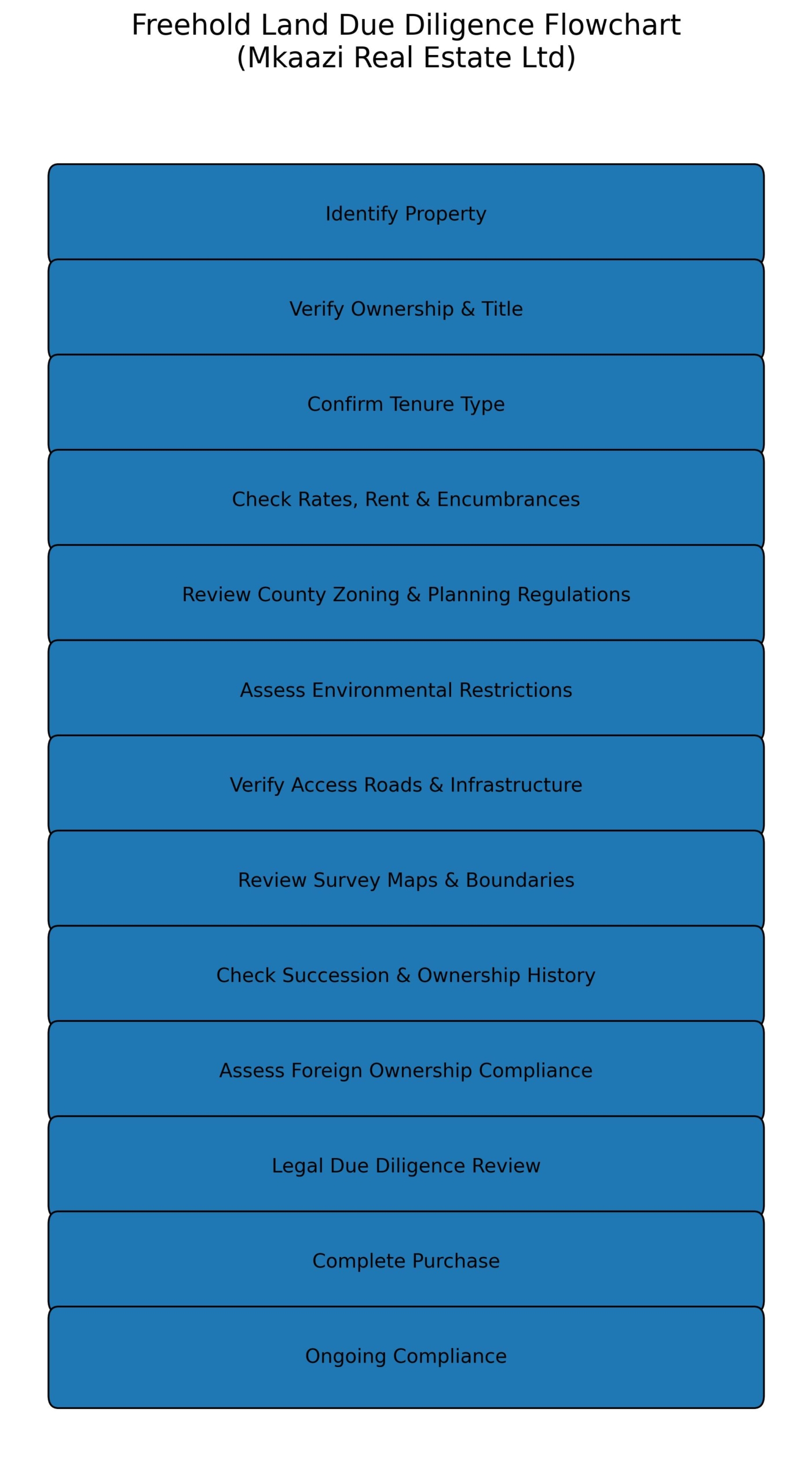
Freehold Ownership Due Diligence Flowchart
Use this checklist before committing to a purchase.
Is Freehold Land Still Worth Buying?
Absolutely.
Freehold ownership remains one of the most desirable forms of land tenure in Kenya.
Benefits include:
- Perpetual ownership
- Strong inheritance potential
- Long-term capital appreciation
- Agricultural flexibility
- Security of tenure
The challenge is not freehold ownership itself.
The challenge is understanding the legal, planning, regulatory, and financial obligations that accompany it.
Well-informed investors continue to acquire freehold land successfully every year.
The key is conducting proper due diligence before making a commitment.
Final Thoughts
Freehold land is often presented as the gold standard of property ownership in Kenya. While it offers significant advantages, it is not without complications.
Foreign ownership restrictions, conversion costs, planning controls, zoning limitations, succession disputes, environmental regulations, county approvals, and ongoing compliance requirements can all affect the value and usability of a property.
Before purchasing any freehold land, investors should ensure they fully understand what they are buying—not just the title, but also the rights, obligations, and restrictions attached to it.
The cost of proper due diligence is small compared to the cost of discovering a problem after purchase.
Need Help Buying Land in Kenya?
At Mkaazi Real Estate Ltd, we help local, diaspora, and international investors acquire property with confidence.
Our Services Include:
✓ Title Verification
✓ Land Due Diligence
✓ Investment Advisory
✓ Property Sourcing
✓ Coastal Property Consultancy
✓ Development Feasibility Assessments
✓ Foreign Buyer Assistance
Contact Mkaazi Real Estate Ltd Today
📞 +254 724 568 989
Don’t just buy land. Buy the right land. Let Mkaazi Real Estate Ltd guide you through every step of the process.




Join The Discussion