

The Complete Guide for Smart Property Investors and Diasporans
Buying land remains one of the most rewarding investments in Kenya. Whether your goal is to build a family home, establish a business, develop rental property, start a farm, or simply hold land for future appreciation, land ownership offers tremendous opportunities for wealth creation.
However, land transactions in Kenya can also present significant risks, even more so when you are not in country to personally handle the process. Cases of forged title deeds, double sales, boundary disputes, fraudulent sellers, and illegal subdivisions continue to affect unsuspecting buyers every year.
At Mkaazi Real Estate, we believe that every buyer should understand the process of land acquisition before committing their hard-earned money. This comprehensive guide will help you navigate the land-buying process safely and confidently.
Why Due Diligence Matters
One of the biggest mistakes buyers make is focusing solely on location and price while neglecting the legal and technical checks that determine whether a property is genuinely available for sale.
Proper due diligence helps you:
✓ Verify ownership
✓ Confirm the property’s legal status
✓ Identify disputes or encumbrances
✓ Avoid fraud and double sales
✓ Ensure smooth transfer of ownership
✓ Protect your investment
The golden rule is simple:
Never pay for land before conducting proper due diligence.
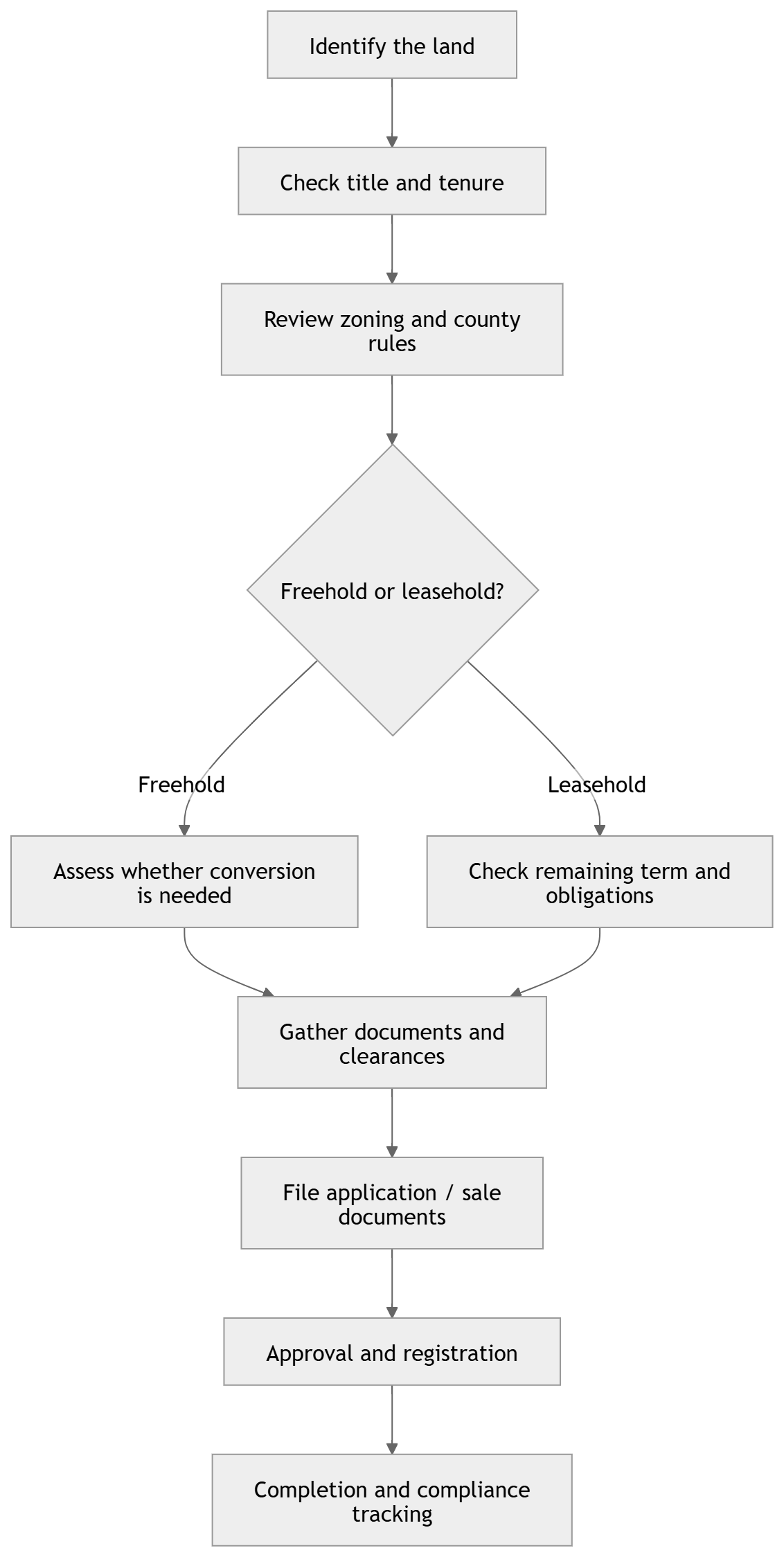
Heres a simple strata of how the purchase process goes, the due diligence process allows you to proceed to the sale if you are satisfied, for thos who want to go right ahead.
Step 1: Work With a Licensed Real Estate Professional
Your first line of defense is choosing the right real estate professional.
Kenya regulates estate agency practice through the Estate Agents Registration Board (EARB), you can click here and do a search of an individual or a firm you want to verify . Before engaging an estate agent or agency, verify that they are registered and authorized to practice.
Benefits of working with a licensed agent/agency include:
- Professional guidance throughout the transaction
- Access to verified listings
- Reduced risk of fraud
- Assistance with documentation and negotiations
- Professional accountability
At Mkaazi Real Estate, as a registered agent with EARB, we have commited ourselves to maintaining high standards of professionalism, transparency, and client protection throughout every transaction.
You can learn more about our services at:
Step 2: Visit the Property Physically
Never buy land based solely on photos, videos, brochures, or online advertisements.
Always conduct a physical site visit.
During your visit:
- Confirm the exact location
- Verify road access
- Assess neighborhood development
- Check availability of utilities such as water and electricity
- Evaluate terrain and suitability for your intended use
- Observe nearby developments
Take time to speak with neighbors and local residents. They often know valuable information regarding:
- Ownership disputes
- Family conflicts
- Succession issues
- Boundary disagreements
- Previous sale attempts
Information gathered on the ground can save you from costly mistakes.
Step 3: Obtain a Copy of the Title Deed
Request a copy of the title deed from the seller.
Review key details including:
- Registered owner’s name
- Land Reference Number (LR Number)
- Parcel Number
- Acreage or land size
- Tenure type (Freehold or Leasehold)
A title deed copy should only serve as the starting point of your verification process—not proof that the land is safe to purchase.
Step 4: Create an ArdhiSasa Account
Today, many land transactions in Kenya are processed through the government’s digital land platform, ArdhiSasa.
ArdhiSasa is the official Ministry of Lands and Physical Planning portal used for:
- Land searches
- Transfer applications
- Stamp duty processes
- Land rent payments
- Title registration services
- Ownership verification
- Tracking land transaction applications
Even in areas where some land records are still maintained physically, many applications, approvals, and payments are increasingly processed through the ArdhiSasa system.
Before beginning a transaction, buyers should create an account on the ArdhiSasa platform.
To register, you will typically require:
- National ID or Passport
- KRA PIN Certificate
- Email Address
- Mobile Phone Number
The official portal can be accessed at:
Creating an account early allows you to monitor transactions directly and avoid over-reliance on third parties.
Step 5: Conduct an Official Land Search
An official search is one of the most important checks in any land transaction.
The search confirms:
- Registered ownership
- Property size
- Existing cautions
- Restrictions
- Court orders
- Charges and mortgages
- Other encumbrances
If any information on the official search differs from what the seller has presented, stop the transaction immediately and seek professional advice.
Never rely on verbal assurances.
Always verify independently.
Step 6: Verify Boundaries and Beacons
A title deed may be genuine while the actual land being shown is not.
This is why boundary verification is essential.
You should:
- Walk the property with the seller
- Identify all existing beacons
- Compare physical boundaries with survey maps
- Confirm neighboring parcels
Where necessary, engage a licensed surveyor to:
- Re-establish missing beacons
- Verify acreage
- Confirm parcel dimensions
- Identify encroachments
Many land disputes in Kenya arise from boundary-related issues that could have been detected before purchase.
Step 7: Confirm Land Use and Zoning Regulations
Not every parcel of land can be used for every purpose.
Before buying, verify:
- Residential zoning
- Commercial zoning
- Industrial zoning
- Agricultural classification
- Environmental restrictions
For example, land intended for agriculture may require approvals before subdivision or change of use.
Understanding zoning regulations prevents future development challenges.
Step 8: Check for Land Rates and Land Rent Arrears
Outstanding government obligations can delay or complicate ownership transfer.
Confirm whether these have been cleared:
County Land Rates
These are charges imposed by County Governments.
Land Rent
Applicable mainly to leasehold properties.
The seller should provide:
- Land rates clearance certificate
- Land rent clearance certificate (where applicable)
Land Settlement Scheme Fund Charge
This is a unique charge mostly on Agricultural properties by the Government of Kenya Throught the Land Settlment Scheme Fund.The Land Settlement Scheme Fund (often referred to as the Settlement Fund Trustee or LSF) is a revolving fund established by the Kenyan government to acquire agricultural land and allocate it to poor, landless citizens. It provides eligible squatters and displaced families with economically viable plots to de-racialize ownership and improve livelihoods .
It typically processes the title deeds for Agricultural Properties at the cost that the allottees can settle over a period of time. Its a small cost but it can accrue interest over years making it a considerable ammount. Its the obligation of the seller to clear it and have a discharge of charge issued by the LSF but mostly they are not able to do so because of financial constraints, and may require part of the purchase price to go to settling it. Transfers cannot be approved before the LSF charge is settled.
Failure to verify these obligations could result in unexpected closing costs.
Step 9: Verify Ownership Identity
Fraudsters often impersonate genuine landowners.
Request:
- National ID
- KRA PIN Certificate
- Passport-sized photographs
- Company registration documents (for corporate sellers)
Cross-check these documents against ownership records.
If the property belongs to a company, ensure that:
- The company legally owns the land
- Directors have authority to sell
- Relevant board resolutions exist
If the owner is deceased, verify that succession proceedings have been completed and administrators have authority to dispose of the property. For this request a copy of the grants and confirmation of the grant that will show you who the new owners are.
Step 10: Engage a Qualified Property Lawyer
A conveyancing advocate plays a critical role in protecting your interests. Ensure the lawyer you choose is duly registered by visiting the LSK website .
Your lawyer should:
- Verify ownership
- Review searches
- Draft or review agreements
- Verify compliance requirements
- Guide the transfer process
- Ensure proper registration
Avoid informal agreements or handwritten contracts without legal review.
Step 11: Sign a Proper Sale Agreement
After satisfactory due diligence, a Sale Agreement should be prepared.
The agreement should clearly state:
- Purchase price
- Deposit amount
- Payment schedule
- Completion period
- Obligations of both parties
- Penalties for breach
- Transfer conditions
Never make substantial payments without a signed Sale Agreement.
Step 12: Obtain Required Consents
Certain transactions require statutory approvals.
Examples include:
Land Control Board Consent
Typically required for agricultural land transactions.
Spousal Consent
Where applicable under Kenyan law.
Corporate Resolutions
For company-owned properties.
Failure to obtain mandatory consents can invalidate a transaction.
Step 13: Complete Transfer and Pay Stamp Duty
Once conditions have been met:
- Transfer documents are prepared
- Property valuation is conducted
- Stamp duty is assessed
- Payment is made
- Ownership transfer is registered
Many of these processes are now integrated into ArdhiSasa and related Ministry of Lands systems.
Keep copies of all receipts and official acknowledgements.
Step 14: Obtain Your New Title and Conduct a Final Search
After registration:
- Obtain the new title deed
- Conduct a final official search
- Confirm ownership reflects your name or company
This final step gives you confirmation that the transfer process has been successfully completed.
Understanding Freehold and Leasehold Titles
Before buying, understand what type of ownership you are acquiring.
Freehold Title
Advantages include:
- Ownership in perpetuity
- Greater flexibility
- Minimal recurring obligations
Common in agricultural and rural areas.
Leasehold Title
Advantages include:
- Common in urban areas
- Often located in developed regions
However:
- Ownership exists for a specified term
- Renewal may be required
- Land rent obligations may apply
Understanding tenure helps you make informed investment decisions.
Common Red Flags Every Buyer Should Watch For
Avoid transactions where:
🚩 The seller refuses to provide original documents
🚩 The price appears unrealistically low
🚩 The seller pressures you to pay immediately
🚩 Multiple individuals claim ownership
🚩 Boundaries do not match maps
🚩 Succession disputes exist
🚩 The seller avoids official searches
🚩 Documents contain inconsistencies
If something feels wrong, investigate further before proceeding.
Why Professional Guidance Matters
Buying land should never be treated as a simple cash transaction.
A safe transaction often requires coordination between:
- Estate agents
- Lawyers
- Surveyors
- Government offices
- Financial institutions
Professional guidance significantly reduces risk and ensures compliance throughout the process.
Final Thoughts
Land remains one of the strongest investment vehicles in Kenya, but only when purchased correctly.
The safest buyers are not necessarily the fastest buyers—they are the most diligent buyers.
Always:
✓ Verify ownership
✓ Conduct official searches
✓ Confirm boundaries
✓ Check rates and rent
✓ Engage professionals
✓ Complete all legal processes
✓ Register ownership properly
Following these steps can save you from costly disputes and protect your investment for generations.
About Mkaazi Real Estate
Mkaazi Real Estate is a trusted Kenyan property company specializing in verified land, residential, commercial, agricultural, and investment properties across Kenya.
Our team assists clients with:
- Property sourcing
- Due diligence
- Site visits
- Investment advisory
- Property sales
- Land acquisition support
Contact Mkaazi Real Estate
📞 +254 724 568 989
Mkaazi Real Estate – Helping You Invest in Property with Confidence, Transparency, and Peace of Mind.




Join The Discussion