
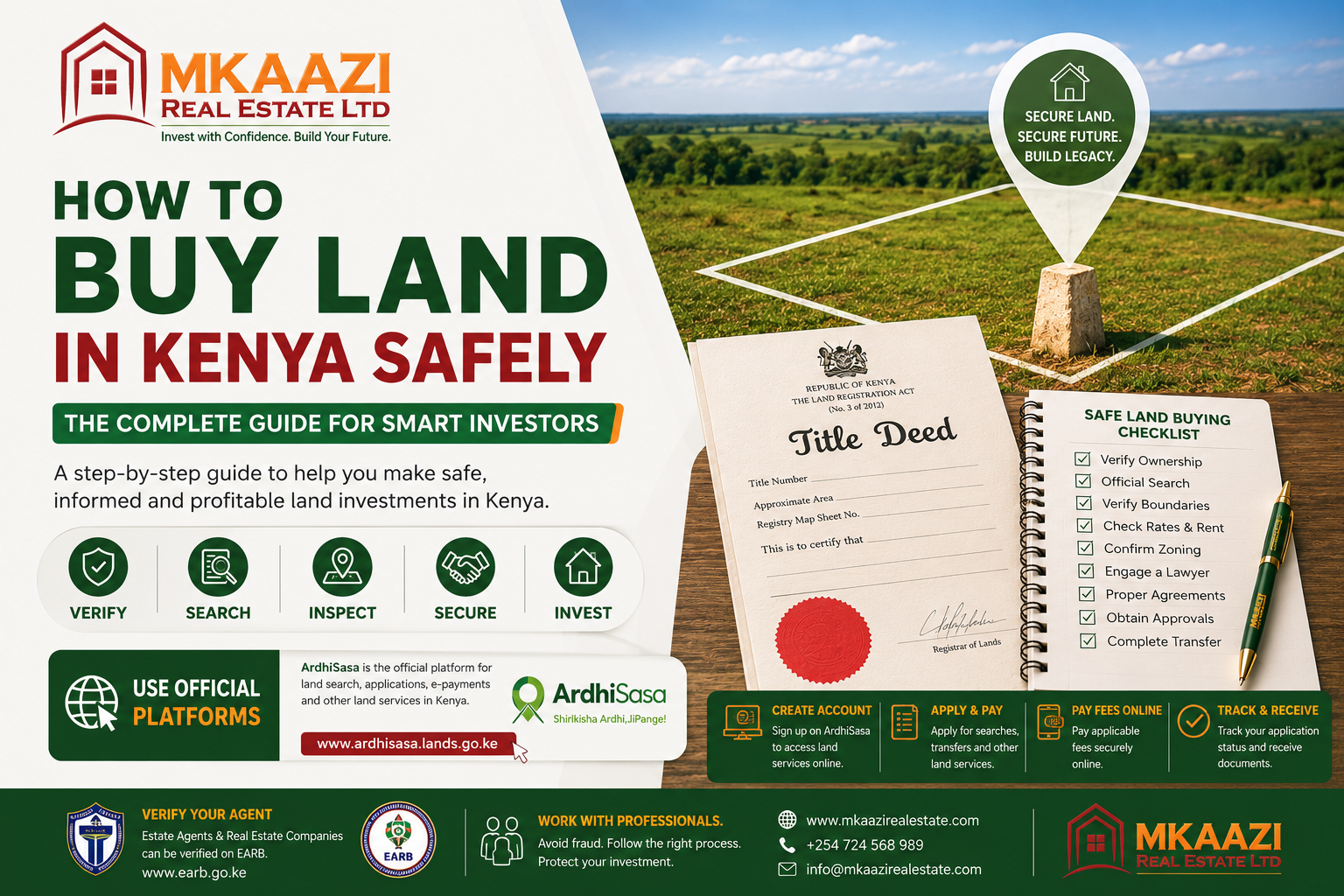
Buying land in Kenya can be rewarding but carries risks like forged titles, unpaid rates, and ownership disputes. This guide covers each step of the due diligence process to help you buy land safely. It shows you how to verify title deeds, conduct official searches on ArdhiSasa (the national land information portal), confirm boundary beacons, check zoning and rates clearance, and complete legal transfer. We explain consent requirements (like Land Control Board approvals), stamp duty, and transfer formalities. We also show how to verify your agent on the official EARB registry. Follow this practical, step-by-step process to protect your investment and ensure a clean title.
Key takeaways:
- Always start with a site visit: Confirm physical boundaries, neighbors, and access before any payments.
- Verify ownership legally: Get the title deed, then perform an official land search on ArdhiSasa to confirm the registered owner and spot charges or caveats.
- Use ArdhiSasa for all applications: Kenya’s Ministry of Lands requires online requests (title searches, LCB consent, transfers) via ArdhiSasa.
- Check agent licensing: Only EARB-licensed agents can handle land sales. Search the EARB directory to confirm any agent or firm (e.g. Mkaazi Real Estate Ltd appears as a registered company).
- Engage professionals: A licensed surveyor and a qualified lawyer are essential to verify boundaries, draft the agreement, and handle transfer documents.
- Inspect approvals: For agricultural land, obtain Land Control Board (LCB) consent. Clear any outstanding land rates and rent certificates before purchase.
- Finalize transfer: After signing the sale agreement, pay stamp duty (4% in municipalities, 2% outside), then submit transfer documents via ArdhiSasa for registration.
By following these due-diligence steps and using official channels (ArdhiSasa, EARB, Ministry of Lands), you minimize fraud risk and ensure your title is sound. Use the checklist and flowchart below to guide your purchase.
1. Identify the Property & Do a Site Visit
- Confirm the location: Visit the land in person. Check that the address or parcel number matches what the seller says.
- Assess physical boundaries: Ask the owner to show all boundary beacons on the ground. Measure them if possible.
- Check access and utilities: Is there a usable road, and are water/electricity lines nearby?
- Talk to neighbors: Local people may reveal if there are disputes, succession issues, multiple claims, or previous sale attempts on the plot. This on-the-ground intel is invaluable.
- Beware of hard sell: If the seller pressures you to buy quickly without inspection, it’s a red flag. A legitimate sale should allow time for full checks.
2. Verify Ownership Documents
- Obtain the Title Deed: Always ask the seller for the original title deed (freehold) or lease (leasehold). Examine it closely:
- Owner’s name and ID should match the seller.
- Check the parcel number, location, and size of the land.
- Note the tenure (freehold vs leasehold) and any listed encumbrances.
- Match details on site: Ensure the physical boundaries match the deed’s description. If not, do not proceed until clarified.
- Be cautious of photocopies: Never rely only on a copy given by an agent. Insist on an official search (next step) to verify the deed.
3. Conduct an Official Land Search on ArdhiSasa
The ArdhiSasa portal (Kenya’s National Land Information System) is used for official title searches and land registry applications. Setting up an ArdhiSasa account (at https://ardhisasa.lands.go.ke) is mandatory for land transactions.
All official land searches must now be done online through ArdhiSasa, Kenya’s digital land registry. Even if you go to a physical registry office, they will require you to use ArdhiSasa to apply and pay.
- Create an ArdhiSasa account:
- Visit ardhisasa.lands.go.ke and click Register.
- Choose Individual (or Company if corporate buyer).
- Provide your National ID number, email, phone number, KRA PIN, and create a password.
- Verify your account via SMS or email when prompted.
- Prepare for the search:
- Use the title deed number or LR/Plot number from the deed.
- Have a scanned copy of your ID ready (new system requires ID upload).
- Apply for the land search:
- In ArdhiSasa, go to Services → Land Registration → Land Search.
- Enter the parcel details and select Land Search.
- Pay the KSh 1,000 search fee (this is the 2026 rate). Payment can be via M-Pesa, bank, or card. Keep the payment receipt.
- Owner Consent: After applying, the system notifies the registered owner to approve the search. You must receive this approval before results are released. If the owner refuses or doesn’t respond, halt the transaction — this is a serious red flag.
- Review the search certificate:
- Once approved (usually within 1–3 business days), download the official search report.
- Check that the registered owner’s name matches the seller’s exactly.
- Note any charges/mortgages (the bank has a claim if present) or cautions/caveats (third-party interests).
- Verify the land size and boundaries on the certificate match what you expect. Any mismatch is a legal problem.
If this official search shows any inconsistencies or existing claims, address them before paying money. A clean search certificate is your strongest protection.
4. Verify Boundaries with a Licensed Surveyor
- Hire a surveyor: Engage a registered surveyor to visit the site. They can locate official beacons (boundary markers) and prepare a sketch (fuller details need full RIM retrieval).
- Cross-check boundaries: Compare the surveyor’s findings with the deed and any available maps. Ensure the plot you’re buying matches the one described by the government.
- Check for encroachments: A surveyor will notice if neighboring developments encroach on the land or if the parcel has been subdivided illegally.
- Obtain official documents: The surveyor can help you acquire the Registry Index Map (RIM) or other official chart to confirm the exact shape and size. This ensures you pay for exactly the land you intend to buy.
Boundary issues are common; resolving them early can prevent later disputes. Never skip this step if boundaries are unclear.
5. Check Land Rates and Land Rent Clearance
- County land rates: Obtain a rates clearance certificate from the county where the land is located. This confirms the owner has paid all property taxes (rates) up to date. Unpaid rates become the buyer’s liability or can halt registration.
- Land rent (leasehold): For leasehold land (common in cities like Nairobi or on leasehold titles), verify that the annual land rent is paid. A Land Rent Clearance Certificate is needed. The State Department of Lands requires this for transfer.
- Where to pay: Use the county’s official channels (MPESA paybill or county offices) to settle any outstanding rates before closing the deal. Keep receipts.
- Evidence: Save the official clearance certificates; they will be required during the registration of transfer.
Failing to clear rates or rent can delay or invalidate your purchase. Always get up-to-date clearance before finalizing anything.
6. Confirm Zoning and Land Use Regulations
- Check zoning: Visit the local county’s planning offices or use ArdhiSasa to ensure the parcel is zoned for your intended use (residential, commercial, agricultural, etc.).
- Development restrictions: Some land may have restrictions (e.g. public protected zones, wetlands, building guidelines). Make sure you can legally do what you plan.
- Future plans: Learn if there are upcoming road projects or developments nearby that might affect the property (good or bad).
Buying land in an area not zoned for your purpose can block your project or require costly rezoning.
7. Obtain Land Control Board (LCB) Consent
- When is LCB consent needed? Under Kenya’s Land Control Act (Cap. 302), any sale, lease, transfer, or subdivision of agricultural land beyond certain sizes requires approval by the local Land Control Board.
- Apply for consent:
- File an application with the relevant County Land Control Board (usually in the sub-county office).
- Include an official search certificate (from ArdhiSasa) and copies of IDs, KRA PINs, and the sale agreement.
- Pay the LCB application fee (e.g. KSh 3,000) and any special consent fee as required.
- Board decision: The LCB will review to ensure the sale doesn’t fragment family land or violate regulations. Consent (if granted) is valid for 6 months.
- Registering consent: Once given, the LCB consent must be endorsed on the transfer documents and registered with the Ministry during transfer.
Don’t skip LCB consent: A transfer without it is illegal and can be overturned. If your land is agricultural, plan for this step as part of due diligence.
8. Hire a Lawyer and Prepare a Sale Agreement
- Engage a property lawyer (advocate): A qualified lawyer protects you. They will:
- Verify all documents and search results.
- Draft or review the Sale Agreement (Agreement for Sale) with clear terms.
- Advise on conditions (price, deposit, timelines, breach remedies).
- Ensure the seller has the legal right to sell (check succession or company documents if needed).
- Confirm compliance with all land laws.
- Verify agent/company via EARB: If you’re working with a real estate agent or company, check they are registered with the Estate Agents Registration Board (EARB). The EARB directory (members.estateagentsboard.or.ke) lets you confirm that both the individual agent and company are licensed. (For example, “Mkaazi Real Estate Ltd” appears listed in the EARB firms directory, but always use the EARB portal to check its current standing.)
- Sign a formal Sale Agreement: Only after due diligence should you enter into a written agreement. Key points to include:
- Parties: Full legal names and IDs of buyer and seller.
- Land details: Parcel number, location, size, title deed number.
- Price and payments: Sale price, deposit amount (usually 10%), and payment schedule.
- Conditions: Subject to receipt of clear searches, LCB consent, and other approvals.
- Completion date: Date by which transfer will be done.
- Default clauses: What happens if either side breaches (forfeiture of deposit, suit for specific performance, etc.).
- Keep records: Every receipt (deposit paid, search fee, lawyer fees, etc.) should be documented. Exchange copies of the signed agreement with the other party.
Never pay the full purchase price upfront. Only a reasonable deposit after signing the agreement, with balance on transfer.
9. Stamp Duty and Transfer of Ownership
- Valuation for Stamp Duty: Before transfer, the land must be valued by the Government Valuer. The valuation certificate fixes the stamp duty payable.
- Pay Stamp Duty: Stamp duty is a tax on property transfer. Current rates: 4% of the land value within city boundaries, 2% outside. (Pay this at a designated bank or via ArdhiSasa payment modules.) Keep the receipt.
- Prepare transfer documents: Your lawyer will lodge documents on ArdhiSasa for Land Registry processing. Required documents include:
- Original title deed (or copies certified for the registrar).
- Sale Agreement.
- Valuation report, stamp duty receipts (from the Commissioner for Domestic Taxes).
- Land rates and land rent clearance certificates.
- LCB consent (if required).
- IDs and PINs of both parties.
- Passport photos of buyer and seller.
- Any other regulator consents (e.g. women’s consent in family deals).
- Submit online: Use ArdhiSasa to apply for “Registration of Transfer of Land”. Upload all documents and pay any registry fees (~KSh 500).
- Registration: The Lands Registrar will process the transfer (usually 7–30 days). When complete, a new title (or lease) will be issued in the buyer’s name.
- Final check: Do one last search or check ArdhiSasa to confirm that the title has been registered to you.
Important: Do not finalize any handover (taking possession) until registration is confirmed. Until the title is officially transferred, the seller remains the legal owner.
Freehold vs Leasehold: Key Differences
| Feature | Freehold Land | Leasehold Land |
|---|---|---|
| Ownership term | Perpetual – you own it outright (subject to title) | Fixed term lease (commonly 33, 50 or 99 years) |
| Renewal | No renewal needed (unless title is restricted). | Must renew or surrender to government on expiry. |
| Land Rent | None (except local rates). | Annual land rent payable to government. |
| Typical locations | Rural and agricultural areas. | Urban centers, developments, strategic areas. |
| Transfer ease | Straightforward (subject to checks). | More formalities (ensure lease is still valid, get govt consent). |
| Risk | Generally lower risk (no expiry). | Risk if lease is near expiry or paperwork flawed. |
Before buying, confirm the tenure on the title. Leasehold plots require checking the remaining lease term and paying any outstanding rents. Freehold is simpler but less common in cities.
Red Flags to Watch Out For
Be cautious and ready to walk away if you encounter:
- Seller won’t show documents: If no original title deed is produced, don’t proceed.
- Extremely low price: Unusually cheap land often hides problems. Compare market rates.
- Pressure tactics: If the seller rushes you or says “trust me, search not needed”, it’s a warning.
- Inconsistent names: The seller’s name differs from the name on the title or search certificate. Even a middle name discrepancy needs explanation.
- Multiple claims: Neighbors or local officials warn of overlapping claims or family disputes.
- Missing boundary markers: If the land’s beacons can’t be located, the exact parcel is unknown.
- No owner consent on ArdhiSasa: If the owner delays or objects to the search, stop the deal – a legitimate seller will have nothing to hide.
- Agent not licensed: Verify on EARB (estateagentsboard.or.ke) that the agent/firm is registered. If not, don’t rely on them.
Whenever in doubt, pause the transaction. It’s far better to lose a deposit opportunity than suffer a fraudulent sale.
Negotiation and Payment Tips
- Negotiate in stages: Use the results of your checks (e.g. missing LCB consent, extra survey cost) as negotiation points if needed.
- Use written records: All offers, counteroffers, and agreements should be in writing (email or text) and attached to the sale agreement.
- Avoid cash: Large cash payments are unsafe and untraceable. Use bank transfers, cheques, or escrow for deposits.
- Escrow accounts: For very large deals, consider a lawyer-controlled escrow or a bank third-party account to hold funds until transfer completes.
- Beware mobile money scams: Never send money to unverified numbers or without confirming the payee (MPESA allows name display; ensure it matches the seller).
- Receipts: Always get a signed receipt for any payment (even deposit) detailing amount, payer, payee, and purpose.
- Professional negotiation: Having your lawyer or a reputable agent handle the negotiation can keep things above board and professional.
Staying cautious with payments is as important as verifying the land. Keep meticulous records of every transaction.
Checklist: Safe Land Buying (Printable)
| Task / Item | Done |
|---|---|
| Visited the land and met neighbors | [ ] |
| Verified the property’s exact location | [ ] |
| Obtained original title deed or lease agreement | [ ] |
| Confirmed seller’s name matches registered owner | [ ] |
| Opened an ArdhiSasa account and applied for search | [ ] |
| Reviewed official land search certificate | [ ] |
| Checked for charges, caveats, inconsistencies | [ ] |
| Hired licensed surveyor to verify boundaries | [ ] |
| Cleared county land rates (got clearance certificate) | [ ] |
| Cleared land rent (for leasehold) | [ ] |
| Confirmed zoning/use with county planning | [ ] |
| Obtained Land Control Board consent (if needed) | [ ] |
| Engaged qualified lawyer for documentation | [ ] |
| Verified agent/company license on EARB | [ ] |
| Signed Sale Agreement with clear terms | [ ] |
| Paid deposit per agreement (got receipt) | [ ] |
| Valuation done & stamp duty paid (got receipts) | [ ] |
| Prepared transfer documents (uploaded via ArdhiSasa) | [ ] |
| Confirmed title registered in my name | [ ] |
Print or screenshot this table to keep on hand as you go. Tick each box only after completing that item.
flowchart LR
    A[Find & inspect land] --> B[Verify title deed]
    B --> C{Do official land search on ArdhiSasa}
    C --> D[Get surveyor to confirm boundaries]
    D --> E[Check rates & land rent clearance]
    E --> F[Obtain LCB consent (if needed)]
    F --> G[Lawyer drafts sale agreement; verify EARB registration]
    G --> H[Sign sale agreement & pay deposit]
    H --> I[Pay stamp duty & submit transfer on ArdhiSasa]
    I --> J[Registrar processes transfer]
    J --> K[Receive new title deed in your name]
This flowchart summarizes the safe land-buying process in Kenya. Each arrow represents a step that must be completed (often concurrently). Skipping steps can lead to legal or financial trouble.
In summary: Buying land safely in Kenya requires patience and thorough checks. Use official systems like ArdhiSasa for searches and transfers, verify all information, and work with licensed professionals. By following these steps and using the above checklist, you guard yourself against fraud and ensure your investment is secure.
Contact Mkaazi Real Estate for Verified Listings:
For guidance on safe land buying or to view verified land listings, contact Mkaazi Real Estate – an experienced agency focused on trustworthy deals. Call/WhatsApp +254 724 568 989 or email info@mkaazi.co.ke. Visit us at www.mkaazirealestate.com.
Mkaazi Real Estate – Helping You Invest in Kenyan Land with Confidence.




Join The Discussion