
An Investor’s Guide to Understanding Coastal Land Scarcity, Property Pricing, and the Future of Land Investment in Malindi
Introduction: The Coastal Property Opportunity Most Investors Are Missing
For decades, Kenya’s coastline has been regarded as one of the country’s most valuable real estate frontiers. Stretching from the Tanzanian border in the south to Lamu County in the north, the coast has attracted everyone from tourism developers and hospitality brands to retirees, diaspora investors, and international property buyers seeking a foothold in East Africa.
Yet according to the recently released HassConsult Coastal Land Report 2025, one of the most important assumptions many investors make about coastal property is fundamentally wrong.
Most people believe there is an abundance of coastal land.
The report demonstrates that the opposite is true.
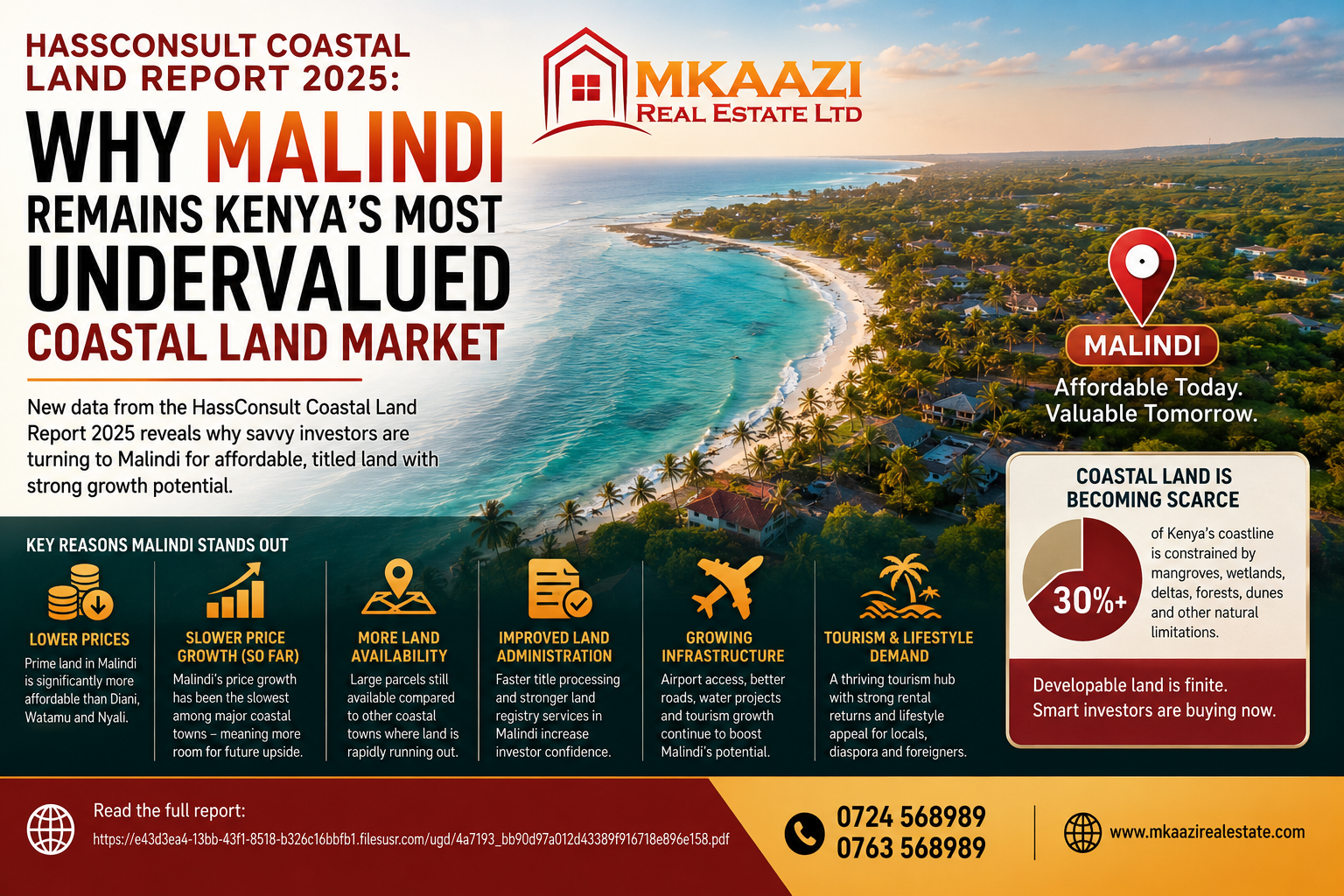
Despite Kenya having approximately 536 kilometres of coastline, a significant portion of this land is either environmentally protected, unsuitable for development, affected by tenure complexities, vulnerable to flooding, or occupied by critical ecological systems such as mangrove forests, wetlands, river deltas, and marine conservation zones.
Read the full report here:
https://e43d3ea4-13bb-43f1-8518-b326c16bbfb1.filesusr.com/ugd/4a7193_bb90d97a012d43389f916718e896e158.pdf
For serious investors, this report raises an important question:
If genuinely developable coastal land is becoming increasingly scarce, where can buyers still find affordable, titled land with strong appreciation potential?
The answer may be Malindi.
While coastal markets such as Diani, Nyali, Bamburi, and Watamu have experienced years of aggressive price growth, Malindi remains one of the few locations where investors can still acquire quality land at relatively accessible prices.
In fact, when one examines the data contained within the HassConsult report alongside current market listings, infrastructure developments, tourism trends, and land availability patterns, a compelling argument emerges:
Malindi may be Kenya’s most undervalued coastal land market today.
Understanding the Report’s Most Important Finding: Coastal Land Is Running Out
One of the most revealing aspects of the HassConsult Coastal Land Report is its analysis of how much coastal land is actually available for development.
The report highlights that substantial sections of Kenya’s coastline are effectively unavailable for private development due to environmental and physical constraints.
Among the most significant restrictions are:
- Mangrove ecosystems
- Wetlands
- River deltas
- Flood-prone lowlands
- Marine parks
- Protected forests
- Sand dune systems
- Community land tenure arrangements
According to the report, more than 100 kilometres of Kenya’s coastline is occupied by wetlands, estuaries, river mouths, tidal creeks, and associated ecological systems.
Additionally, approximately 30 percent of the coastline is constrained by natural features that either prohibit or significantly limit development.
For investors, this has enormous implications.
The value of land is determined by two fundamental factors:
- Demand
- Scarcity
As developable coastal land becomes increasingly scarce, the remaining parcels with clear title deeds, infrastructure access, and development potential become more valuable.
This trend is already visible in Kenya’s premium coastal markets.
The question is whether Malindi will follow the same trajectory.
Why Malindi Has Not Yet Fully Repriced
Perhaps the most compelling investment argument for Malindi lies in what has not happened yet.
Unlike Diani and Watamu, Malindi has not experienced the same level of speculative price acceleration.
For many investors, this may appear to be a weakness.
In reality, it may be one of Malindi’s greatest strengths.
Historically, the strongest property investments are rarely found in markets that have already reached peak popularity.
They are found in markets where:
- Infrastructure already exists
- Demand is growing
- Prices remain comparatively affordable
- Land is still available
- Future growth drivers are clearly visible
Malindi satisfies all five conditions.
The town already possesses a functioning tourism economy, established residential neighbourhoods, an international airport, banking infrastructure, hospitals, international schools, and a mature hospitality sector.
Yet land values remain significantly lower than in several competing coastal markets.
This creates an unusual disconnect between intrinsic value and market pricing.
For investors, such disconnects create opportunity.
Comparing Malindi with Other Coastal Markets
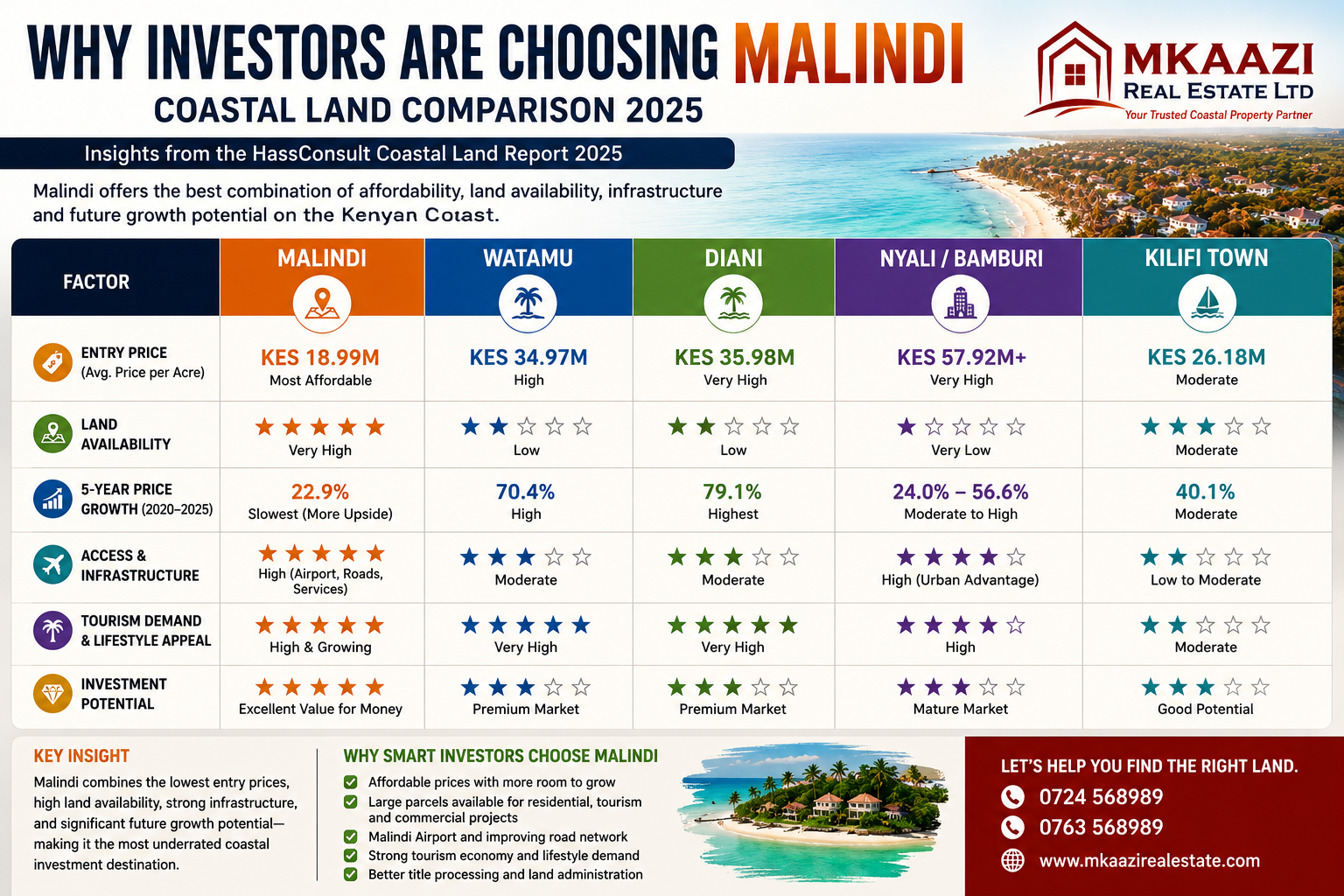
To understand why Malindi represents such compelling value, it is important to compare it with other coastal destinations.
Diani: A Mature Premium Market
Diani remains one of Kenya’s most successful tourism destinations.
However, success has consequences.
Land prices have risen dramatically over the past decade.
Many prime beachfront opportunities have already been acquired.
New investors entering Diani today are often purchasing at mature-market pricing.
While Diani remains attractive, much of the early-stage appreciation has already occurred.
Malindi offers a different proposition.
Investors are entering at significantly lower acquisition costs while still benefiting from established tourism demand.
Watamu: International Demand Driving Premium Pricing
Watamu has become one of East Africa’s most internationally recognised tourism destinations.
Its popularity among European buyers has contributed to strong appreciation in property values.
However, the same international demand that has made Watamu desirable has also increased barriers to entry.
Large development parcels are increasingly difficult to acquire.
Land suitable for hospitality projects often commands premium pricing.
For investors seeking value, Malindi frequently offers better land-to-price ratios.
Simply put, buyers can often acquire larger parcels in Malindi for a fraction of the cost of comparable opportunities in Watamu.
Nyali and Bamburi: Urban Constraints
Nyali and Bamburi benefit from their proximity to Mombasa.
Yet urbanisation has significantly reduced land availability.
Large parcels are increasingly rare.
Infrastructure congestion is becoming more common.
Development costs continue rising.
Malindi avoids many of these challenges.
It offers room for expansion while maintaining strong connectivity.
The Availability Advantage
One of the most important themes throughout the HassConsult report is land scarcity.
Ironically, this is precisely where Malindi excels.
While much of Kenya’s coastline faces increasing supply constraints, Malindi continues to offer access to multiple categories of investment land.
Investors can still find:
- Beachfront property
- Ocean-view plots
- Sand dune developments
- Residential plots
- Commercial land
- Agricultural acreage
- Riverfront parcels
- Forest-adjacent land
- Eco-tourism sites
- Tsavo corridor opportunities
Few coastal markets in Kenya offer this level of diversity.
This matters because diversified land availability attracts multiple categories of buyers.
And multiple categories of buyers create stronger long-term demand.
The Hidden Value of Malindi’s Sand Dune Corridor
One particularly fascinating section of the HassConsult report examines coastal geomorphology.
The report identifies the Mambrui-Sabaki area as one of Kenya’s significant coastal dune systems.
To some observers, sand dunes may appear to be a development constraint.
Experienced investors see something different.
Elevated land.
Ocean views.
Natural drainage.
Reduced flood exposure.
Unique tourism experiences.
Globally, elevated coastal land often commands premiums because it provides both scenic value and climate resilience.
The Mambrui dune corridor may therefore represent one of the most overlooked investment opportunities along the Kenyan coast.
Mkaazi Real Estate has already observed growing interest from buyers seeking elevated coastal sites suitable for boutique hospitality developments and private residences.
Climate Resilience Is Becoming a Real Estate Asset
One of the most forward-looking aspects of the HassConsult report concerns climate resilience.
As sea-level rise and flooding become increasingly important considerations globally, investors are paying closer attention to site selection.
The report notes that flood-prone areas often experience weaker long-term performance than elevated sites.
This trend has already been observed in numerous international coastal markets.
Properties positioned on:
- Elevated terrain
- Stable dune systems
- Coral terraces
- Inland ridges
Often outperform lower-lying alternatives over time.
Many areas surrounding Malindi possess exactly these characteristics.
For long-term investors, this could become an increasingly important value driver.
Why the Tsavo Corridor Could Be the Next Growth Frontier
While much attention focuses on beachfront land, some of the most exciting opportunities may lie inland.
The Malindi-Tsavo corridor offers a combination rarely found elsewhere in East Africa.
Investors can still acquire substantial acreage at relatively modest prices while maintaining access to one of Africa’s most famous wildlife ecosystems.
Potential uses include:
- Safari lodges
- Eco-camps
- Wellness retreats
- Glamping developments
- Conservation tourism
- Carbon credit projects
- Sustainable agriculture
As experiential tourism continues growing globally, these opportunities may become increasingly valuable.
The ability to acquire large parcels at current prices may not exist indefinitely.
Improved Land Administration Is Changing Investor Confidence
Historically, one of the biggest concerns surrounding coastal property investment was land administration.
Title verification often required extensive effort.
Searches could be time-consuming.
Transfer processes were frequently delayed.
Today, the situation is improving significantly.
The strengthening of land administration services within Malindi has increased transparency and efficiency.
The relocation and expansion of registry functions means buyers can now conduct:
- Ownership searches
- Title verification
- Transfer processing
- Survey confirmation
More efficiently than in the past.
This is particularly important for diaspora and foreign investors who require confidence before committing capital.
Properties with a single ownership history are becoming especially attractive because they simplify due diligence and reduce legal risk.
Why Foreign Investors Are Paying Attention
Kenya remains one of Africa’s most accessible real estate markets for international investors.
Foreign buyers are permitted to hold leasehold interests and participate in tourism, residential, and commercial development projects.
Compared with competing destinations across Africa, Malindi offers:
- Lower acquisition costs
- Established tourism demand
- International accessibility
- Stable legal structures
- Strong lifestyle appeal
- Development flexibility
For foreign investors seeking affordable exposure to African coastal real estate, few destinations offer a comparable combination of affordability and potential.
The Investment Thesis: Why Malindi May Be the Best Risk-Adjusted Coastal Market in Kenya
The HassConsult Coastal Land Report ultimately points toward a simple conclusion.
Coastal land is becoming scarcer.
Environmental constraints are increasing.
Development-ready parcels are becoming more valuable.
Yet Malindi remains comparatively affordable.
Investors today can still acquire land with:
- Clear title deeds
- Tourism potential
- Infrastructure access
- Development flexibility
- Long-term appreciation prospects
Without paying the premium prices seen elsewhere along the coast.
This combination of affordability and future potential is rare.
And it is precisely why some of the most informed investors are increasingly focusing their attention on Malindi.
Conclusion: The Window of Opportunity May Not Remain Open Forever
Every successful property market follows a similar pattern.
At first, only local investors recognise the opportunity.
Then early adopters arrive.
Infrastructure improves.
Demand increases.
Prices accelerate.
Eventually, the market matures.
The HassConsult Coastal Land Report suggests that Kenya’s coastal land market is entering a new phase defined by scarcity and selectivity.
In that environment, locations that combine affordability, accessibility, tourism appeal, legal clarity, and available land are likely to outperform.
Malindi stands out on every one of these measures.
For investors looking beyond today’s prices and focusing on tomorrow’s opportunities, Malindi remains one of Kenya’s most compelling land investment destinations.
Looking for Verified Land Opportunities in Malindi?
Whether you are seeking beachfront property, residential plots, agricultural land, commercial opportunities, or tourism development sites, Mkaazi Real Estate Ltd provides local expertise, verified listings, and professional guidance throughout the buying process.
Contact Mkaazi Real Estate Ltd
📞 0724 568989
📞 0763 568989
🌐 www.mkaazirealestate.com
Explore verified opportunities today and discover why more investors are choosing Malindi as their gateway to Kenya’s coastal property market.



Join The Discussion